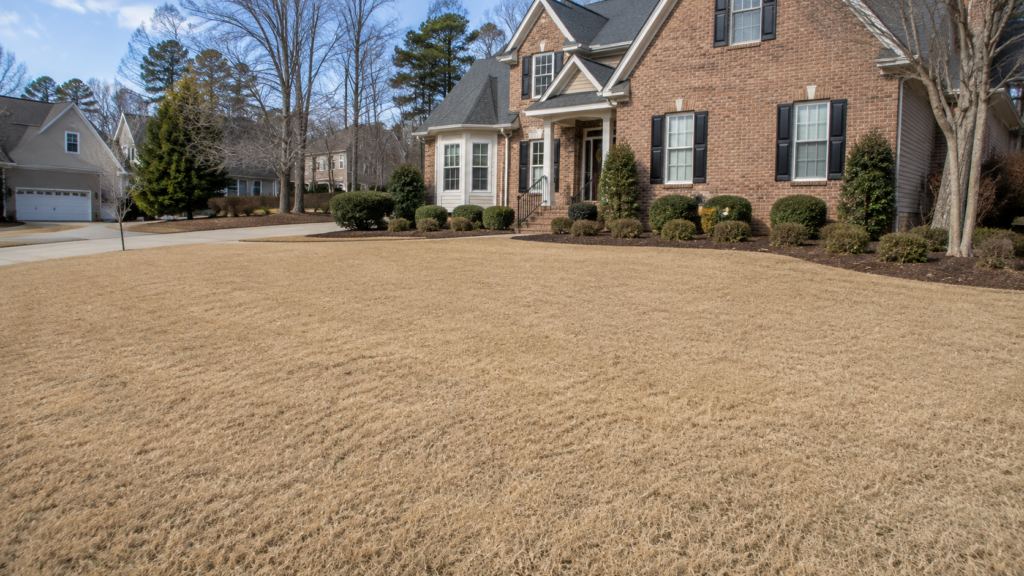
You bought a brand-new home in Charlotte. The house looks great, but the lawn tells a different story.
Maybe the grass is thin, yellow, or full of bare spots. You seed it. You water it. You add fertilizer. Some grass comes up, then stalls or disappears a few weeks later.
After a few rounds of this, it is easy to start wondering what you are doing wrong.
In many new construction lawns, the real problem is underneath the grass.
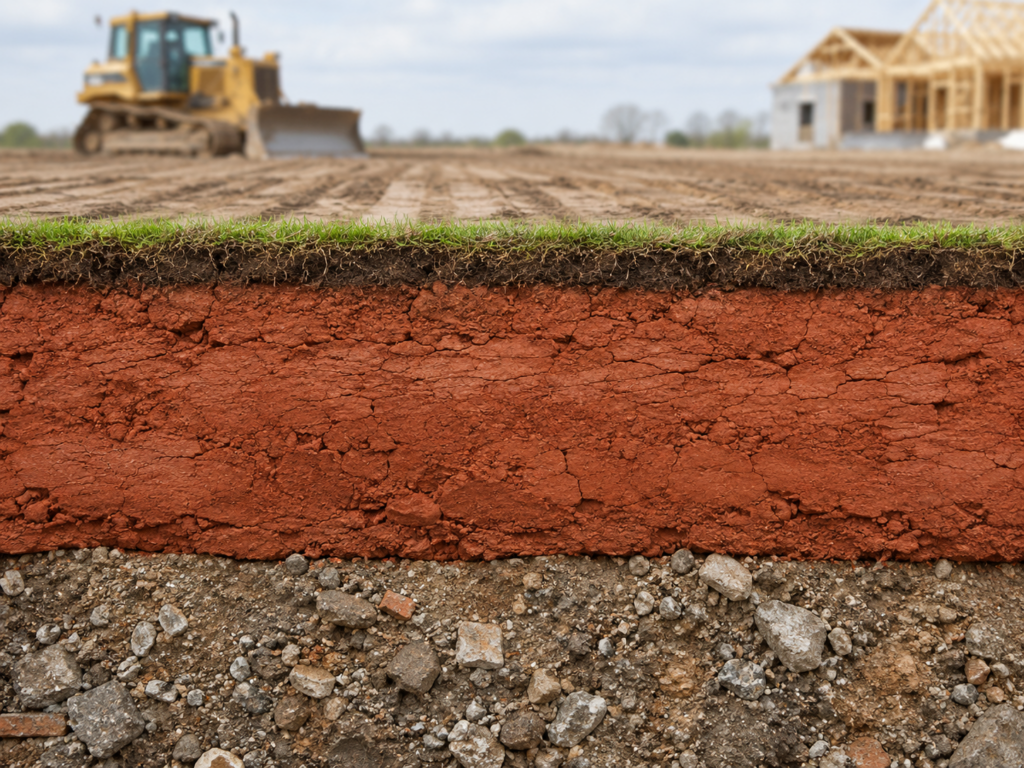
Before you ever moved in, grading and heavy construction equipment may have removed good topsoil, packed the remaining soil tightly, and exposed the dense red clay common around Charlotte.
That creates three problems at once:
- Grass roots struggle to push through compacted soil.
- Water may run off or sit near the surface instead of moving into the root zone.
- Acidic soil can make important nutrients harder for grass to use.
So adding another bag of seed or fertilizer may not solve the problem.
Andrew Powell, owner of Advanced Turf Care, has spent more than 20 years working with turf in Carolina conditions. One lesson becomes clear very quickly with struggling new-build lawns: you have to understand the soil before you can fix the grass.
That is what we are going to do here.
You will learn what construction can do to your soil, why Charlotte’s red clay can make the problem worse, how soil pH affects your lawn, and how to test what is actually happening below the surface.
Then we will walk through a practical recovery plan so you can stop guessing and start fixing the conditions your grass needs to grow.
What Construction Does to Your Soil: The Hidden Damage
A new construction lawn can look fine at first, especially if fresh sod was installed before you moved in.
The problems often show up later, once the grass starts depending on the soil underneath.
That is when thin growth, yellowing, bare patches, poor drainage, and weak roots begin to make sense.
The Topsoil Heist: Where Your Good Dirt Went
Healthy topsoil contains organic matter, nutrients, air space, and biological activity that help grass roots grow.
During construction and grading, some or much of that upper soil layer may be removed, disturbed, or mixed with lower-quality subsoil.
What is left can be very different from the soil a healthy lawn needs.
Instead of several inches of loose, fertile soil, your grass may be growing over:
- Dense red clay
- Low-organic-matter subsoil
- Construction fill
- Mixed soil from grading
- A very thin layer of topsoil beneath sod
This is why adding seed alone often fails.
The seed may germinate near the surface, but young roots eventually reach the poor soil underneath. Growth slows, the grass becomes stressed, and thin areas return.
The problem is bigger than pH alone. Construction can change the entire root zone your lawn depends on.
Compaction: When Heavy Equipment Packs the Soil Tight
Think about how many times heavy equipment crosses a building lot.
Bulldozers, loaders, trucks, and grading equipment place enormous pressure on the soil. Over time, that pressure squeezes out the air spaces between soil particles.
Charlotte’s clay can become especially dense when this happens.
Compacted soil creates several problems:
- Roots struggle to grow deeper.
- Water has trouble soaking into the soil.
- Oxygen movement around the roots decreases.
- New grass develops a shallow root system.
- The lawn becomes more vulnerable during hot, dry weather.
You may even notice water pooling after rain or running across the surface instead of soaking in.
That is a strong clue that compaction may be part of the problem.
Why Fertilizer Cannot Fix Compaction
This is where many homeowners waste money.
They see pale or weak grass and assume the lawn needs more fertilizer.
But fertilizer cannot create space for roots.
If the root zone is packed tightly, the grass still has limited access to water, oxygen, and usable soil volume no matter how much fertilizer you spread.
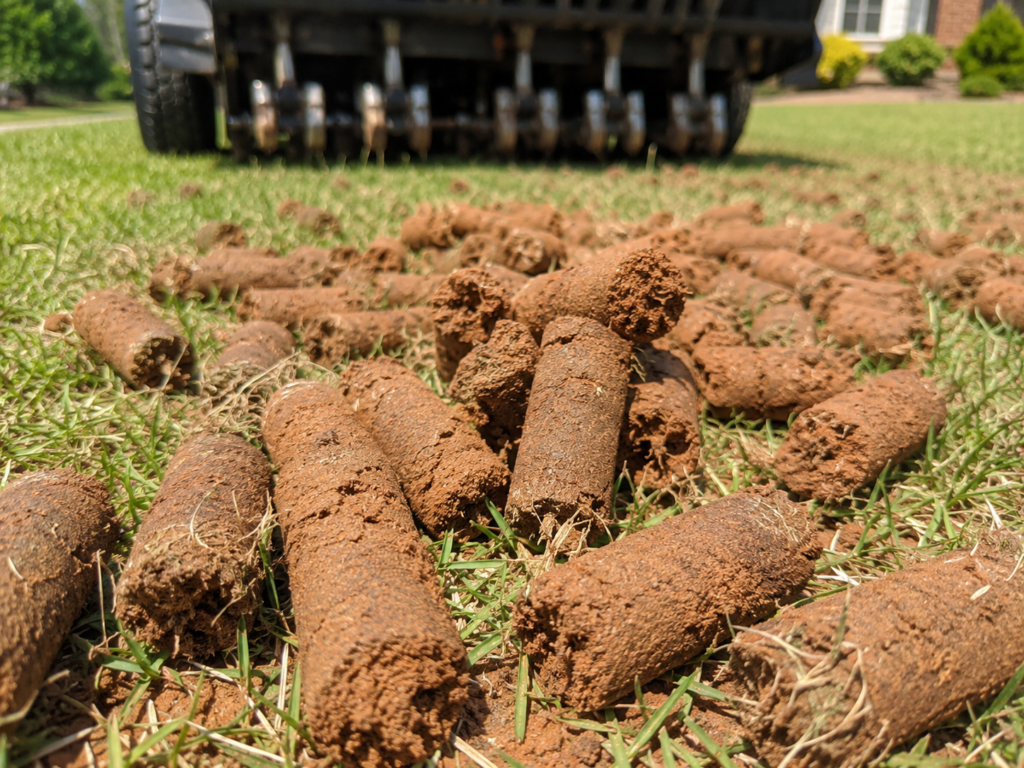
For heavily compacted lawns, core aeration can help by physically removing small plugs of soil and creating openings through the compacted surface.
It is much different from simply poking holes with spikes.
On Charlotte clay, those open channels can give air, water, and future soil amendments better access to the root zone.
Fill Dirt: You May Not Have the Same Soil Across Your Yard
Builders sometimes need additional soil to shape lots, create proper grades, or fill low areas.
That means one part of your lawn may contain native clay while another contains imported fill or disturbed subsoil.
You can end up with several different growing conditions in one yard.
That helps explain why one section may stay reasonably green while another struggles no matter what you do.
Fill soil can also contain very little organic matter. Without that organic material, the soil may hold water poorly, compact easily, and provide a difficult environment for grass roots.
What If Sod Was Installed Directly Over Clay?
This is especially common in new lawns.
Fresh sod can look beautiful because it already has a developed layer of grass and roots.
But if those roots hit dense, compacted clay underneath, they may have trouble growing deeper.
You may notice the lawn looking good for a few months and then slowly declining.
That does not necessarily mean the sod was bad.
It often means the soil underneath was never prepared well enough to support it long term.
In these situations, repeated fertilizing alone will not correct the root-zone problem. Improving soil structure through practices such as core aeration and adding organic matter can be much more important.
The first goal is not to force the grass to grow harder.
It is to give the roots better soil to grow into.
Charlotte’s Native Soil: Why Red Clay and Acidity Are a Double Problem
Construction damage is only part of the story.
Around Charlotte, many lawns already start with dense, acidic red clay. Once construction removes or disturbs the better topsoil above it, grass can be left trying to grow in conditions that were never ideal for shallow turf roots.
The Cecil Series: Charlotte’s Signature Red Clay
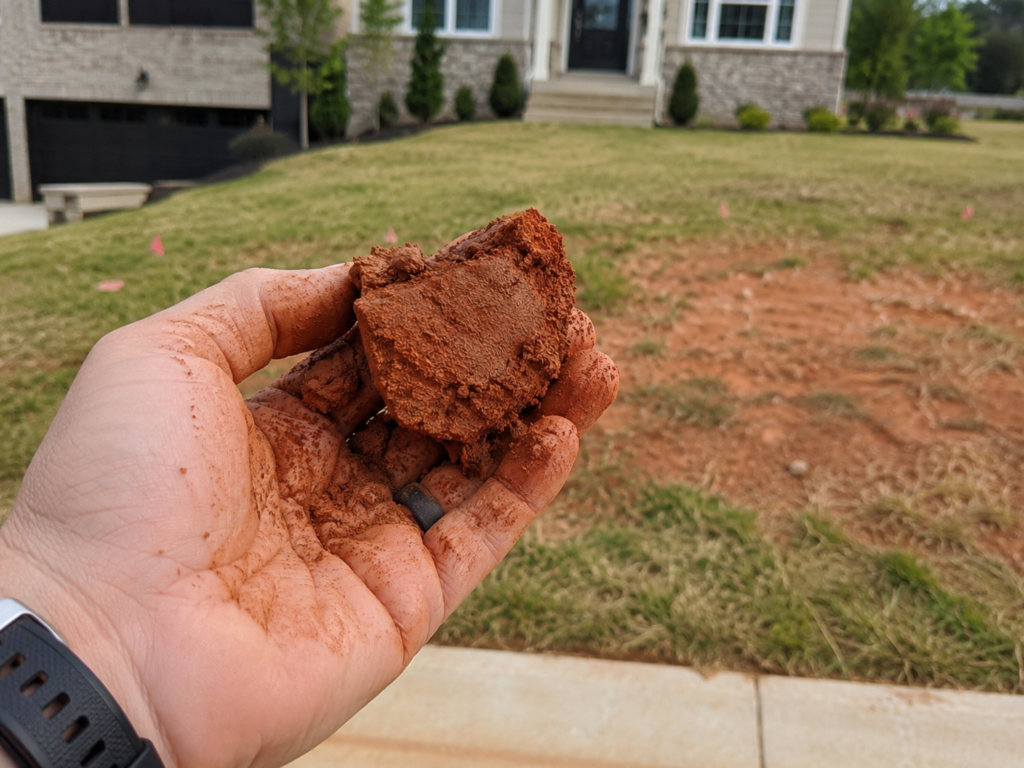
The Charlotte Piedmont is well known for Cecil-series red clay, North Carolina’s official state soil.
Its red color comes largely from iron compounds in the soil. It is naturally acidic and can become very dense when compacted by construction equipment.
For a homeowner, that creates two immediate challenges:
- Roots have a harder time pushing deeply into the soil.
- Low soil pH can reduce how efficiently grass uses certain nutrients.
This is why advice written for sandy or loose soils in other parts of the country often does not translate perfectly to a new construction lawn in Charlotte.
Why Low pH Matters
Soil pH tells you how acidic or alkaline your soil is.
When the pH is too low for your grass type, nutrient availability changes. Even when nutrients are present in the soil, the grass may not be able to use them as efficiently.
You may see:
- Thin growth
- Pale or yellow-green grass
- Weak root development
- Slow recovery after stress
That is why simply adding more fertilizer can become an expensive cycle. If the soil chemistry is wrong, adding more nutrients does not necessarily solve the underlying problem.
Lime Is Not Fertilizer
This is an important distinction.
Lime does not feed your lawn. It is a soil amendment used to raise soil pH when a soil test shows that correction is needed.
By moving the pH toward the appropriate range for your turf, lime can create better conditions for nutrients already in the soil, and nutrients added later, to be used more effectively.
But you should never guess how much lime your lawn needs. Too much can create a different set of problems.
Compaction + Acidity Is the Real Trouble
Now put both problems together.
Your grass may have shallow roots because the clay is compacted. At the same time, low pH may be limiting how well those roots use nutrients.
That is why some Charlotte new construction lawns keep struggling even after repeated seeding and fertilizing.
The grass may not be the real problem. The root zone is.
Before buying another bag of seed or fertilizer, the next step is finding out what is actually happening in your soil.
Soil pH Explained: The Nutrient Gatekeeper
You have heard us mention soil pH several times. So what does it actually mean?
What Is Soil pH?
Soil pH measures how acidic or alkaline your soil is on a scale from 0 to 14.
For your lawn, think of pH as a gatekeeper for nutrients. When the soil is too acidic, grass may have a harder time using some of the nutrients it needs, even when those nutrients are already present.
That helps explain a frustrating situation we see often: you fertilize the lawn, but the color and growth barely improve.
The fertilizer may not be the whole problem. The soil conditions may be limiting what the grass can actually use.
What pH Should a Charlotte Lawn Have?
The right number depends on your grass type.
NC State recommends keeping most North Carolina turfgrasses roughly around the 6.0 to 6.5 range, with some guidance placing the optimum closer to 6.5 to 7.0. Centipedegrass is different and prefers more acidic soil, around 5.5.
That is one reason you should never apply lime simply because your lawn looks weak.
Test first. Lime second.
Your soil test tells you whether the pH actually needs to change and how much lime is appropriate.
Nutrient Lockout: Why More Fertilizer May Not Help
When soil becomes too acidic, nutrient availability changes. Phosphorus can become less available, while very acidic conditions can also increase the availability of elements such as manganese to unwanted levels.
For the grass above ground, the symptoms can look pretty simple:
- Weak or slow growth
- Thin turf
- Poor color
- Roots that struggle to develop
- Little improvement after fertilizing
But do not assume yellow grass automatically means low pH. Compaction, moisture problems, disease, nutrient deficiencies, and other stresses can look similar.
That is why a soil test is much more useful than guessing from color alone.
And one more thing homeowners often misunderstand: lime is not fertilizer.
Lime changes soil chemistry when the pH is too low. It helps create a better root-zone environment so your turf can make more effective use of available nutrients.
The table below shows how nutrient availability changes as soil pH rises or falls.
pH-Nutrient Availability Reference Table
Soil pH does not tell you how much fertilizer is in the soil. It tells you how easily many nutrients can remain available for grass roots to use.
NC State notes that nutrient availability is strongly tied to soil pH. In North Carolina mineral soils, many nutrients are most available around pH 5.8 to 6.2, while turf-specific guidance places most lawn grasses around 6.5 to 7.0 for optimum nutrient availability.
Here is a simplified homeowner reference:
| Soil pH | N | P | K | Ca & Mg | Fe & Mn | Overall Lawn Conditions |
|---|---|---|---|---|---|---|
| 4.0–4.5 | Poor | Very Poor | Reduced | Very Low | Very High | Very Poor |
| 5.0 | Reduced | Poor | Fair | Low | High | Poor |
| 5.5 | Fair | Improving | Fair | Improving | High | Fair |
| 6.0 | Good | Good | Good | Good | Available | Good |
| 6.5 | Very Good | Very Good | Very Good | Very Good | Available | Excellent |
| 7.0 | Good | Good | Good | Good | Declining | Good |
| 7.5 | Reduced | Reduced | Good | High | Low | Fair |
| 8.0 | Reduced | Poor | Fair | High | Very Low | Poor |
This table shows general nutrient-availability trends, not the actual nutrient levels in your lawn. A soil test is still needed before applying lime or fertilizer.
Why Very Acidic Soil Causes Trouble
Below about pH 5.5, several problems can begin stacking up.
Phosphorus becomes less efficient because aluminum in acidic soil can bind with it. At the same time, manganese becomes more soluble and can reach harmful concentrations when acidity becomes severe.
Iron and manganese actually become more available as soil becomes acidic, not less. That is why we would not describe every nutrient as simply being “locked out” at low pH.
For most Charlotte homeowners, the important takeaway is much simpler:
Too low is a problem. Too high is a problem. The goal is the right range for your specific grass.
For most turfgrasses, NC State recommends roughly 6.5 to 7.0, while centipedegrass prefers soil closer to 5.5.
That is exactly why the next step should be a soil test, not another guessed application of lime or fertilizer.
The Hidden Cost of Doing Nothing: A Charlotte Water Bill Calculator
The Watering Trap: Why More Water Won’t Fix Bad Soil
When a new construction lawn struggles, most homeowners do the same thing.
They water more.
That feels logical. But if the soil is compacted and the root zone is unhealthy, more water often means more runoff, more puddling, and more frustration.
The grass still struggles. The bill just gets bigger.
A Simple Charlotte Water Cost Example
Let’s use a 5,000-square-foot lawn.
Say you irrigate enough to apply about 0.75 inches of water per week.
That works out to roughly:
- 2,336 gallons per week
- About 10,100 gallons per month
- About 13.5 Ccf per month (1 Ccf = 748 gallons)
Charlotte Water currently charges $6.30 per Ccf for the first 16 Ccf used through a dedicated irrigation meter.
At 13.5 Ccf per month, that amount of irrigation would cost about $85 per month in water-usage charges alone.
If your irrigation runs through your regular household meter instead, the exact impact can vary because Charlotte uses tiered residential water rates. Additional outdoor water use can push part of your monthly consumption into the higher-priced tiers.
Over a 4- to 5-month growing season, 13.5 Ccf of irrigation per month through a dedicated irrigation meter would equal roughly:
- $340 to $425 in water-usage charges
- Potentially more if irrigation runs through a regular household meter and pushes total usage into higher tiers
Compare That to Fixing the Soil
Now compare that with a basic DIY soil-correction plan for the same lawn:
- Soil test: $0 from April 1 through November 30, $5 during peak season
- Pelletized lime: $30 to $50
- Compost: $60 to $100
- Core aerator rental: About $79+
- Tall fescue seed: $40 to $60
Estimated starting total: About $209 to $300+
That is the real takeaway.
In many cases, one season of wasted watering costs close to the same as actually starting to fix the problem.
What This Means for Homeowners
If your lawn has poor soil health, watering harder is usually not the answer.
You do not need to keep feeding the symptom.
You need to fix the root-zone problem that is causing the grass to fail in the first place.
And that starts with a soil test, not a longer sprinkler schedule.
Note: These numbers are illustrative. Your actual cost depends on your irrigation amount, rainfall, and how Charlotte Water charges your property. Always check your own bill for exact rate impact.
How to Test Your Soil pH in Charlotte: The First Step

Before you buy lime, fertilizer, compost, or another bag of grass seed, test the soil.
For a struggling new construction lawn, this is one of the smartest first steps you can take.
Why a Lab Test Beats Guessing
A basic home pH kit may give you a rough number. The NCDA&CS Agronomic Services lab gives you information you can actually use to make treatment decisions.
The test measures soil pH and acidity, evaluates plant-available nutrients, and provides lime and fertilizer recommendations based on what you plan to grow. For residential properties, recommendations are given in pounds per 1,000 square feet.
In other words, instead of asking, “Should I throw some lime down?” you can know whether your lawn needs lime and how much.
How to Collect a Lawn Soil Sample
You do not need special equipment. NCDA&CS recommends an official soil sample box, a clean plastic bucket, and a soil probe, shovel, spade, or garden trowel.
Then:
- Take soil from 8 to 10 random spots across the lawn.
- For an established lawn, sample about 4 inches deep.
- Mix all the cores together in your clean bucket.
- Fill the official NCDA&CS sample box to the marked red line.
- Label the box and complete the homeowner submission form.
- List your lawn and grass type so the lab can provide the correct recommendations. If one part of your yard looks or feels completely different from another, test those areas separately. That is especially useful on new construction lots where grading and fill soil can create different soil conditions across the same property.
Where Charlotte Homeowners Can Get a Soil Test
The N.C. Cooperative Extension Mecklenburg County Center provides official soil sample boxes to residents.
Mecklenburg County Center 2415 Lester St. Charlotte, NC 28208
Sample boxes are available during business hours, and the Extension office also keeps boxes outside for pickup when the office is closed.
Completed samples are analyzed by the NCDA&CS Agronomic Division in Raleigh. If mailing through USPS, use 1040 Mail Service Center, Raleigh, NC 27699-1040. UPS and FedEx shipments go to 4300 Reedy Creek Road, Raleigh, NC 27607.
What Does Soil Testing Cost in 2026?
Here is an important update.
As of August 2026, NCDA&CS soil testing is free for North Carolina residents from April 1 through November 30. Beginning December 1, 2026, the peak-season charge is $5 per sample.
So your first step may actually cost you nothing.
Andrew’s rule after more than 20 years around Carolina turf is simple: test first, treat second.
Guessing at lime or fertilizer can waste money and sometimes create another soil problem. A soil test gives you a starting point based on what is actually happening beneath your grass.
Interpreting Your Soil Report: What the Numbers Mean for Your Lawn
Getting the report is only useful if you know what to do with it.
The good news is that you do not need to understand every number on the page. For a struggling lawn, focus first on pH, lime recommendations, phosphorus, and potassium.
Start With Your Soil pH
Your soil pH tells you whether the soil is too acidic for the grass you are trying to grow.
If the pH is below the target range, the NCDA&CS report provides a lime recommendation. That recommendation is based on more than the pH number alone, which is why two lawns with the same pH may need different amounts of lime.
Follow the report, not a generic lime rate.
That matters especially on Charlotte’s clay soils, which can require more lime to change pH than lighter sandy soils.
What About Phosphorus and Potassium?
The report also shows a Phosphorus Index (P-I) and Potassium Index (K-I).
NCDA&CS uses these numbers to decide whether your lawn actually needs more phosphorus or potassium. For homeowner reports, an index above about 50 is generally considered sufficient for fertilizer recommendations.
A disturbed new-build lawn may have low or uneven nutrient levels, but do not assume it does.
Let the soil report make that decision.
Turn the Report Into a Simple Plan
Think of your results as instructions:
- Low pH? Apply the recommended lime.
- Low phosphorus or potassium? Use the fertilizer recommendation on the report.
- pH and nutrients look good? Look harder at compaction, drainage, irrigation, or other causes.
This is where soil testing saves money. You stop treating the lawn based on what you think is wrong and start treating what the test actually found.
DIY vs. Professional: What Should You Budget For?
For a 5,000-square-foot lawn, costs can vary a lot depending on how much lime the test recommends, how much soil preparation is needed, and whether you already own the equipment.
| Item | DIY | Professional |
|---|---|---|
| NCDA&CS soil test | $0–$5 per sample* | May be included |
| Core aeration | About $79+ for a short rental | Charlotte services currently start around $101 |
| Lime | Depends on soil-test rate | Depends on rate + labor |
| Compost/topdressing | Depends heavily on volume and delivery | Quote required |
| Aeration + tall fescue seeding | Seed + equipment/materials | Charlotte services currently start around $270 |
*NCDA&CS currently offers free testing outside its peak-fee period, with a $5 peak-season fee beginning December 1, 2026. Equipment and professional-service prices change, so treat these as planning numbers rather than fixed quotes.
If the lawn only needs aeration and overseeding, DIY may make sense.
If you are dealing with severe construction compaction across a large lot, paying for commercial equipment and experienced application can save a lot of physical work.
The Charlotte Lawn Remediation Plan: Step-by-Step
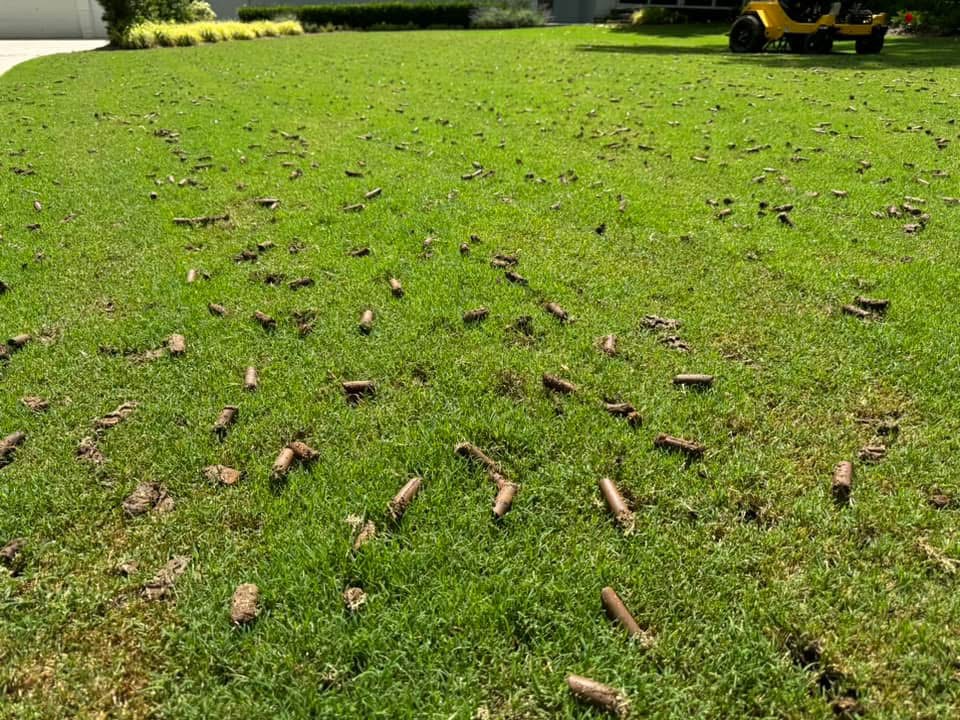
Once you know what the soil needs, the recovery process becomes much simpler.
For a tall fescue lawn in Charlotte, fall is usually the best time to put the major pieces together.
Step 1: Core Aerate the Compacted Soil
Use a core aerator, not a spike aerator.
A core aerator removes plugs of soil, creating space for air and water while reducing compaction. NC State specifically recommends coring for compacted clay soils and notes that spike aeration can make compaction worse.
For tall fescue in the Piedmont, fall is the preferred renovation period. Aerate when the soil is moist enough for the machine to pull good plugs, but not soaked.
Leave the plugs on the lawn. They will break down naturally.
Step 2: Apply Lime Only If the Test Calls for It
Now look at your soil report.
Do not automatically spread 50, 75, or 100 pounds of lime because another Charlotte lawn needed that amount.
Apply what your report recommends.
For an established lawn, NC State advises applying no more than about 50 pounds of lime per 1,000 square feet at one time. If more is needed, split the application. Aerating before a surface lime application can also help.
And do not automatically choose dolomitic lime. If magnesium is low, dolomitic lime makes sense. Otherwise, calcitic lime may be appropriate.
Step 3: Add Organic Matter Where It Makes Sense
Construction soil often needs more than chemistry. It needs better structure.
If you are working with bare soil before establishing the lawn, NC State recommends incorporating compost into heavy clay when possible. For an existing lawn, properly cured compost can be used as a light topdressing.
Keep topdressing thin so you do not bury the existing grass.
The goal is gradual improvement, not covering the lawn with several inches of compost.
Step 4: Choose Turf-Type Tall Fescue for a Cool-Season Lawn
For many Charlotte homeowners who want a green cool-season lawn, turf-type tall fescue is the standard choice.
NC State recommends using a blend of turf-type cultivars rather than relying on one variety. The recommended seeding rate is about 6 pounds per 1,000 square feet.
For a 5,000-square-foot lawn, that works out to roughly 30 pounds of seed.
Bermudagrass and zoysiagrass can also perform well in the region, but they are warm-season grasses with a different establishment schedule and maintenance plan.
Step 5: Seed at the Right Time and Keep It Moist
For tall fescue in the Piedmont, September is prime renovation time. NC State’s lawn calendar recommends overseeding thin areas as weather cools, generally from September 1 into early October.
After seeding, the seedbed must stay moist.
That often means light watering several times per day at first, rather than one deep watering. Once seedlings establish, gradually reduce the frequency and encourage deeper rooting.
This is one place homeowners often get confused.
Frequent light watering is for germination. Deep, less frequent watering is for established grass.
Step 6: Protect the Lawn Through Its First Year
Getting seed to germinate is only the beginning.
For tall fescue:
- Mow around 3 to 3.5 inches once the grass is ready.
- Never remove more than one-third of the leaf blade at one mowing.
- Follow the soil-test fertilizer recommendation instead of feeding heavily.
- Avoid pushing tall fescue with heavy nitrogen during Charlotte’s spring and summer heat.
- Water established turf as needed during dry periods rather than keeping the soil constantly wet.
Most importantly, give the soil time.
Lime can begin reacting relatively quickly when moisture is available, but the full change can take 6 to 12 months, especially when lime is applied to the surface instead of incorporated.
That is why a badly damaged new construction lawn rarely becomes perfect after one weekend.
Fix the soil first. Establish the grass second. Then build density season by season.
Charlotte Lawn Recovery Timeline: Month-by-Month Expectations
A badly damaged new construction lawn does not recover in a few weeks.
This timeline assumes you are establishing or repairing a tall fescue lawn in Charlotte and beginning in early fall. NC State recommends September 1 through October 1 as the main overseeding window for Piedmont lawns.
| Month | What to Do | What You May Notice |
|---|---|---|
| September | Soil test, core aerate compacted areas, apply recommended amendments, and seed thin or bare areas. | Do not expect instant improvement. This month is about fixing the root zone and establishing seed. |
| October | Keep newly seeded areas consistently moist. Begin mowing once seedlings are established and tall enough. | New grass starts filling bare areas and the lawn begins looking noticeably greener. |
| November | Reduce watering frequency as roots develop. Keep fallen leaves off young grass. | Fescue continues establishing roots as temperatures cool. |
| December | Keep leaves and debris off the lawn. Avoid unnecessary traffic on wet soil. | Top growth slows, but tall fescue can remain green through much of Charlotte’s winter. |
| January | Mostly leave the lawn alone. Watch for drainage or standing-water problems after winter rain. | Very little visible growth is normal. |
| February | Review your soil-test recommendations and prepare for spring maintenance. | Growth begins picking up as conditions improve. |
| March | Mow as needed and deal with weeds carefully. Avoid aggressive spring renovation unless necessary. | The lawn should begin actively greening and thickening. |
| April | Continue mowing and fertilize only as appropriate for your lawn and soil results. | A successful fall planting should now look much more established. |
| May | Start preparing the lawn for summer stress. Water based on need rather than on a fixed daily schedule. | Healthy areas should be denser, but weak root zones may start showing stress. |
| June | Mow tall and avoid pushing excessive growth. Watch for heat stress and disease. | Tall fescue can begin struggling as Charlotte becomes hotter and more humid. |
| July | Focus on keeping established turf alive rather than forcing it to stay perfect. | Some thinning or discoloration during severe heat is not unusual. |
| August | Inspect thin areas and plan your next fall aeration and overseeding if needed. | Summer damage becomes easier to see, giving you a clear plan for fall. |
| September, Year 2 | Aerate compacted areas again if needed and overseed remaining thin spots. Retest soil when appropriate before adding more lime. | This second fall is often when improvements in density become much more noticeable. |
NC State recommends delaying aeration of tall fescue until fall and warns that summer heat and humidity can increase stress and disease pressure.
Do Not Expect Your pH to Follow a Calendar
We intentionally left exact monthly pH numbers out of this timeline.
A lawn does not move predictably from pH 4.8 in September to 5.5 in February and 6.5 by summer. The response depends on the original soil pH, soil type, buffering capacity, lime material, application rate, moisture, and whether the lime was incorporated.
That is why you should confirm progress with another soil test rather than guessing from the calendar.
The goal during the first year is simple: improve the soil, establish deeper roots, survive the first Charlotte summer, and repair whatever remains the following fall.
For a severely damaged new construction lawn, progress is usually measured season by season, not week by week.
When to Call a Professional for a New Construction Lawn
DIY work can fix a lot, especially when the problem is mild compaction or a simple pH imbalance.
But some lawns need more than a weekend project.
Signs You May Need Professional Help
Consider bringing in a lawn professional if:
- The soil is extremely hard and compacted across most of the yard.
- Water regularly pools or runs off instead of soaking in.
- Large areas keep failing after repeated seeding.
- You have a large property that would require significant equipment and material.
- You are unsure how to interpret the soil test or build a treatment plan.
Complex drainage or grading problems may also need a contractor who specializes in that type of work.
Questions to Ask Before Hiring Anyone
A good lawn company should be able to explain why your lawn is struggling, not just sell you another treatment.
Ask:
- Do you recommend soil testing before making major soil amendments?
- How do you handle compacted Charlotte clay?
- Do you use core aeration for compacted turf?
- How do you decide whether lime or fertilizer is actually needed?
- What should I realistically expect during the first year?
Be cautious if the entire solution is simply “more fertilizer.”
With more than 20 years of turf experience, Andrew Powell and the Advanced Turf Care team look at the lawn as a complete system. Soil conditions, grass type, seasonal timing, weeds, nutrition, and compaction all affect the result.
That kind of diagnosis matters much more than throwing products at symptoms.
Prevention: What to Ask Your Builder Before the Lawn Goes In
If your home is still under construction, you have an advantage.
You can ask questions before the sod or seed goes down.
Ask These Questions Before Closing
Talk with your builder about:
- How much usable topsoil will remain after final grading.
- Whether the soil will be tested before the lawn is installed.
- Whether lime or other amendments will be added if the test calls for them.
- What grass type is being installed.
- How drainage will move water away from the home and across the yard.
You can also ask whether additional topsoil or soil preparation can be included before planting.
It is much easier to improve the soil while the ground is still open than after a finished lawn is already struggling.
Already Moved In?
You can still fix the problem.
Start by testing the soil and identifying whether you are dealing with compaction, low pH, poor nutrient levels, or a combination of several issues.
Once you know the cause, you can stop guessing and build the lawn back one step at a time.
Your Lawn’s Comeback Starts With the Soil
If your new Charlotte lawn keeps failing, another bag of seed may not be the answer.
The real problem may be sitting a few inches below your feet.
Construction can leave behind compacted clay, poor soil structure, and pH conditions that make it difficult for grass to establish strong roots.
So start simple.
Test the soil. Fix what the test shows. Relieve compaction where needed. Then give the grass time to establish.
That is the approach Andrew and the Advanced Turf Care team have learned to trust after more than 20 years of working with Carolina turf.
You do not need to keep guessing.
You just need to start with the right problem.
Need Help With Your Lawn?
Get professional lawn care built around your property, grass type, and seasonal needs.
Get a Free Quote