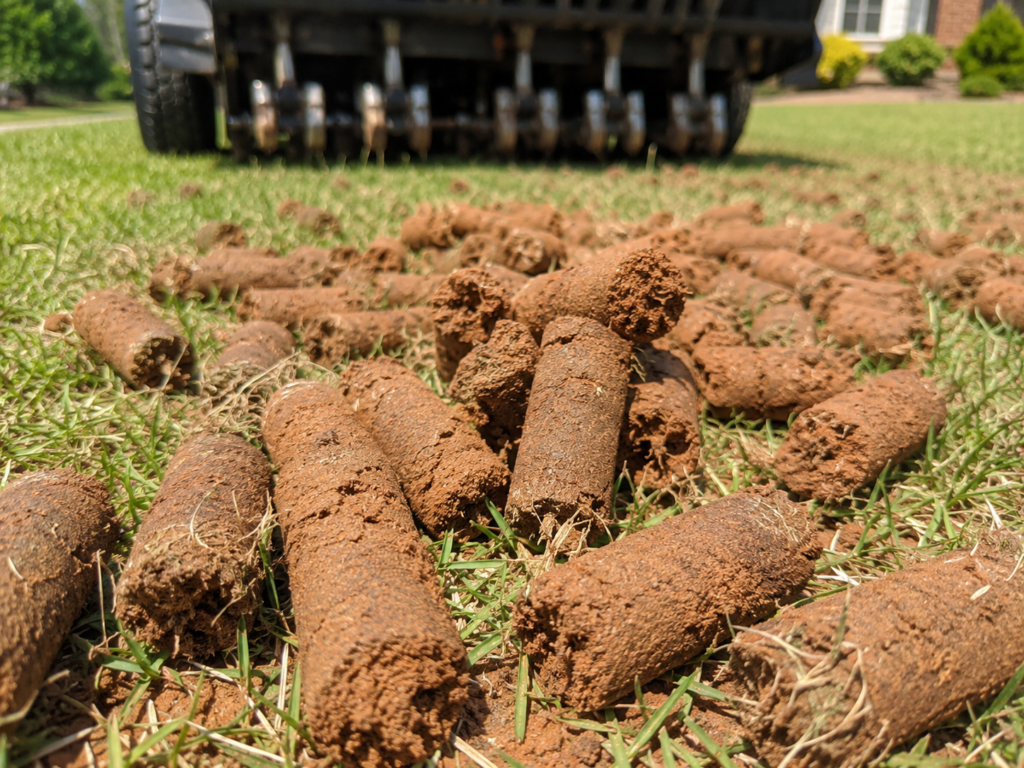
You mowed, watered, and fertilized your Bermuda grass all summer. It looked strong going into fall. Then February arrived, and green clumps of poa annua, chickweed, and henbit started showing through the dormant brown turf.
I see this across Charlotte every winter.
The problem is usually not poor effort. It is missed timing. Winter weed seeds can begin waking up before your Bermuda does. Once they germinate, a pre-emergent cannot turn back the clock.
Generic advice to “apply in late winter” does not help much here. Charlotte may see a warm stretch in January, followed by freezing weather in March. A fixed calendar date can leave you applying too early, too late, or twice because you are unsure whether the first treatment worked.
The better approach is to watch the soil.
After more than 20 years of managing Bermuda lawns in Mecklenburg County, I have learned that a simple soil probe tells you more than the weekly weather forecast. Your pre-emergent needs to go down before the soil at a 2-inch depth stays within the weed-germination range.
This guide explains how to find that window, choose a product that is safe for dormant Bermuda, put it down evenly, and water it in correctly. You will also get a month-by-month winter plan, the mistakes I see most often, and a practical checklist you can follow without guessing.
Understanding Bermuda Dormancy in Charlotte’s Climate
What Dormancy Looks Like and What It Doesn’t
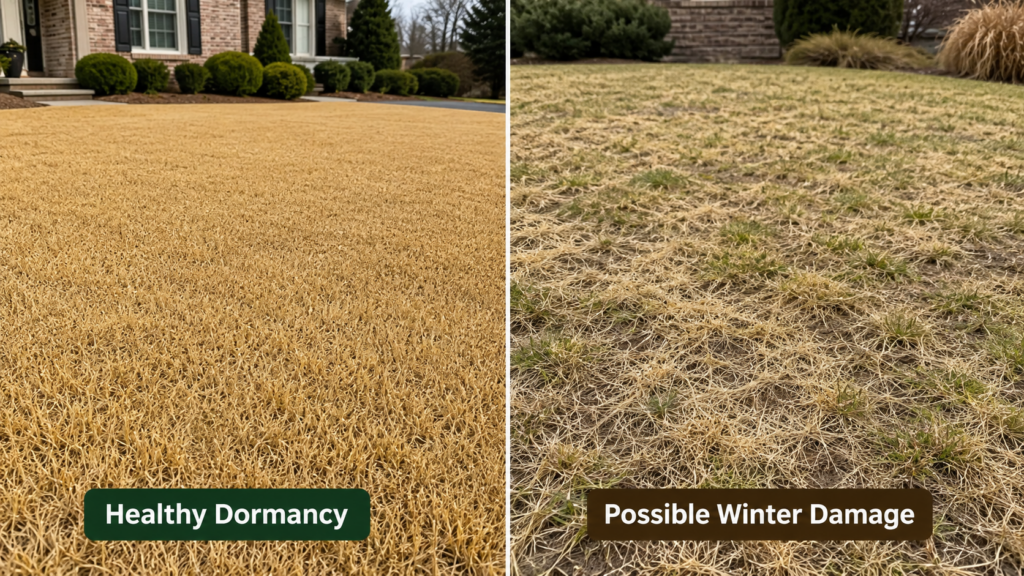
After Charlotte’s first hard frost, Bermuda grass stops growing and slowly turns tan or brown. This usually happens during November.
That color change is normal.
The grass is not dead. It is protecting its crowns and storing energy below the soil until warmer spring conditions return. This seasonal behavior is one of the main differences homeowners notice when comparing tall fescue and Bermuda grass in the Carolinas.
A healthy dormant Bermuda lawn should look:
- Fairly even in color
- Dry and tan above the soil
- Firmly rooted when gently pulled
- Free from large, wet, or matted patches
Winter kill looks different. Dead areas often appear straw-colored, thin, or flattened. They may also pull away from the soil with little resistance.
Try a gentle tug test if you are unsure. Dormant Bermuda usually holds firm because its crowns and roots are still alive. Grass damaged by severe winter kill may pull up easily.
Do not rush to reseed a brown lawn in January. Wait for spring green-up before deciding which areas are truly damaged. Homeowners considering repairs should also understand which grass seed works best for North Carolina lawn conditions before buying a bag based only on the label.
Why Dormancy Doesn’t Mean “Do Nothing”
Dormant Bermuda still needs basic protection.
Windy, dry weather can pull moisture from the crowns. Fallen leaves can block sunlight, trap moisture, and smother thin areas. Winter weeds can also grow through the brown turf before Bermuda begins to wake up.
Keep the lawn clear of:
- Thick leaf cover
- Fallen branches
- Standing water
- Heavy foot traffic during frost
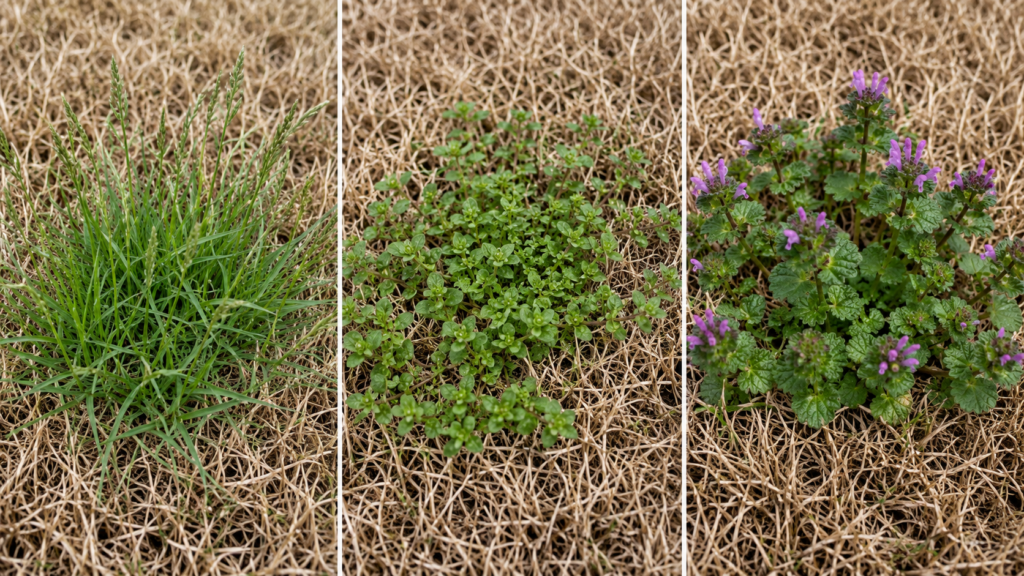
- Green patches of poa annua, chickweed, or henbit
Bermuda is tough, but dormancy is not a free pass. A little winter attention protects the crowns, limits weed competition, and gives the lawn a cleaner start when Charlotte temperatures rise.
The Pre-Emergent Window: Timing Based on Soil Temperature
Why Soil Temperature, Not the Calendar, Rules
Do not put down pre-emergent simply because the calendar says February.
Charlotte can have several warm days followed by another hard freeze. Soil beneath a sunny slope may also warm faster than soil beside the shaded north wall of your home.
Your lawn’s soil temperature is the better guide.
One important distinction: the 50°F to 55°F late-winter window mainly applies to crabgrass and other summer annual weeds. NC State reports that crabgrass begins germinating when soil temperatures move above roughly 53°F to 58°F.
Winter annuals follow a different schedule:
- Poa annua begins germinating in late summer or fall as soil cools below about 70°F.
- Chickweed and henbit also begin establishing during cooler fall conditions.
- Their primary pre-emergent application should therefore go down in late summer or early fall, before germination begins.
A February application may catch later-germinating weeds, but it cannot stop poa annua that is already growing.
How to Monitor Soil Temperature Like a Pro
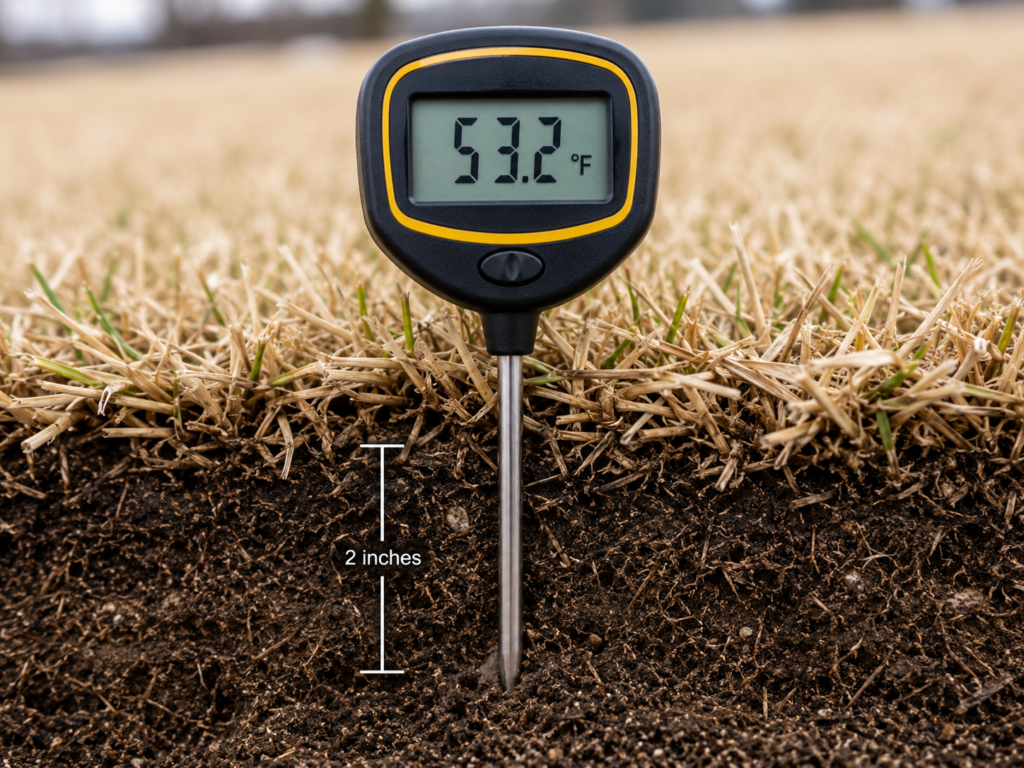
Use a digital soil thermometer with a probe long enough to reach several inches into the ground. You do not need expensive equipment. A basic garden soil probe will do the job.
Starting in early February:
- Insert the probe about 2 inches into the soil.
- Check an open, representative part of the lawn.
- Take the reading between 8 and 9 a.m.
- Repeat the test in two or three areas.
- Record the results for at least three mornings.
When the three-day average approaches 50°F, prepare to put down your spring pre-emergent. Aim to finish before the average remains near 55°F.
Check more than one area. Soil beside pavement may be several degrees warmer than soil in shade. A south-facing slope may also reach the trigger before a flat backyard.
The NC State Climate Office’s ECONet can help you follow regional soil trends, but its stations measure soil temperature at about 10 centimeters, or roughly 4 inches. Use that information as a cross-check, not a replacement for a 2-inch reading in your own lawn.
Charlotte Soil Temperature and Pre-Emergent Action Table
Charlotte does not have a reliable citywide 2-inch soil-temperature station that represents every lawn. The ranges below are practical planning ranges, not official five-year climate normals.
| Month | Working Soil Range | What to Do |
|---|---|---|
| January | Below 50°F in most lawns | Buy your product, measure the lawn, and calibrate your spreader or sprayer. |
| February | Often rising toward 50°F | Begin daily readings. Apply spring pre-emergent when the three-day average reaches about 50°F. |
| March | Commonly moving through 55°F | Apply immediately if the soil is still below the trigger. Once crabgrass germinates, pre-emergent cannot kill the plants already growing. |
| April | Usually above the main trigger | Focus on summer weed prevention only if the label still permits an application. Do not apply where you plan to seed Bermuda soon. |
These are planning windows, not fixed appointments. Your soil probe gets the final vote.
Choosing the Right Pre-Emergent for Bermuda Grass
Active Ingredients That Are Safe and Effective on Dormant Bermuda
Choose the active ingredient before choosing the brand.
Two bags may have similar names but contain different herbicide strengths, fertilizer amounts, and application rates. Read theactive ingredient,percentage, andturf species on the label before buying.
For established Charlotte Bermuda lawns, these are the main options:
- Prodiamine: A strong choice when you apply before germination and want longer residual control. It controls labeled weeds such as poa annua, chickweed, henbit, and crabgrass. The current Barricade 4FL label lists established Bermuda lawns and allows single or sequential applications.
- Dithiopyr: A practical option when the spring crabgrass window is getting tight. Unlike most pre-emergents, it can also control very young crabgrass after germination. It will not remove established poa annua or mature broadleaf weeds.
- Pendimethalin: A widely available choice for crabgrass, annual bluegrass, chickweed, and several other annual weeds. It is labeled for established Bermuda, but shorter control may make a split program more useful.
- Isoxaben: Better for small-seeded broadleaf weeds than grassy weeds. It may help with chickweed and henbit, but it normally needs a grass-controlling partner for broader coverage.
Pre-Emergent Herbicide Comparison
| Active Ingredient | Brand Examples | Best Use | Bermuda Safety | Rate Guidance |
|---|---|---|---|---|
| Prodiamine | Barricade, Stonewall | Long residual and broad annual-grass prevention | Labeled for established Bermuda | Barricade 4FL lists 0.5 to 1.1 fluid ounces per 1,000 square feet as the annual-use range for established Bermuda. Select the weed-specific rate from the label. |
| Dithiopyr | Dimension | Crabgrass prevention with limited early post-emergent activity | Labeled for Bermuda lawns | Rates change by formulation, region, and treatment program. Follow the exact container label. |
| Pendimethalin | Pendulum, some Halts products | Budget-friendly prevention of annual grasses and some broadleaf weeds | Labeled for established Bermuda | Liquid and granular rates are not interchangeable. |
| Isoxaben | Gallery | Broadleaf weeds such as chickweed and henbit | Product-specific | Use only when the exact label includes your turf and intended application. |
Do not copy a rate from another product just because the active ingredient matches.
Also check whether a granular product contains nitrogen. During Bermuda dormancy, I prefer a herbicide-only formulation unless a soil test and proper nutrient plan indicate that fertilization is needed.
One more correction: atrazine is not automatically unsafe for dormant Bermuda. NC State lists atrazine or simazine as November or December options for certain winter weeds. They are different tools, however, and should not be treated as substitutes for a properly timed spring pre-emergent.
Step-by-Step DIY Pre-Emergent Application Guide
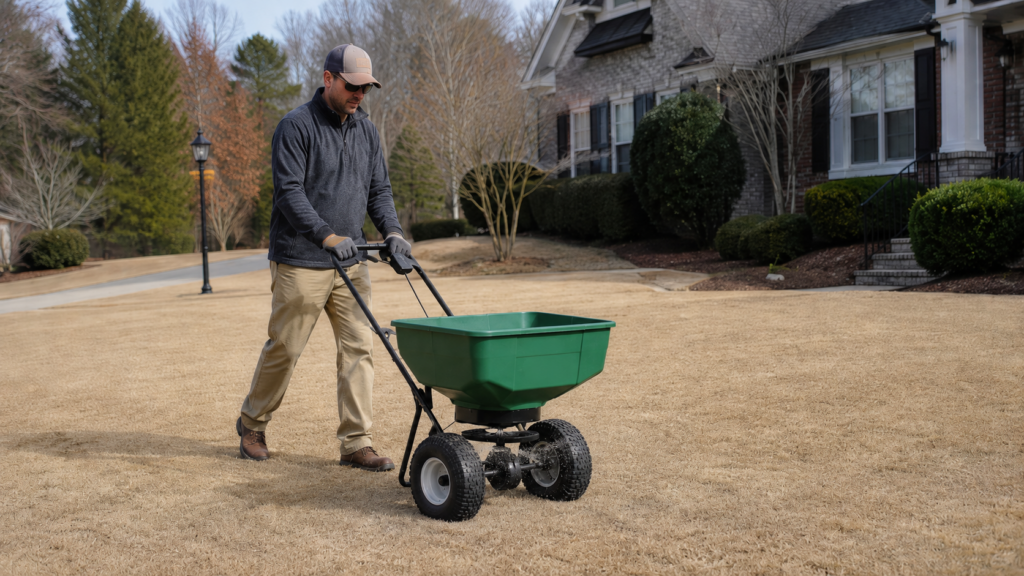
Before You Start: Equipment and Preparation
Gather everything before you open the product.
You will need:
- Your chosen liquid or granular pre-emergent
- A broadcast or drop spreader for granular products
- A 1- to 2-gallon pump sprayer for liquid products
- A digital soil thermometer
- A measuring cup or small scale
- Gloves, eye protection, and long sleeves
- A hose, sprinkler, or planned rainfall for activation
Measure your lawn before calculating how much product to use. Guessing the square footage often leads to too little coverage or an application that exceeds the label rate.
Calibrate your equipment next. This is where many DIY applications go wrong.
For granular products, weigh the amount needed for a measured test area. Start with a low spreader setting and adjust until the product runs out at the end of that area.
For liquids, fill the sprayer with plain water and practice your walking speed and spray pattern first.
Application Steps for Liquid or Granular Products
- Mow and clear the lawn.Remove leaves, branches, and heavy debris so the product can reach the soil. Avoid scalping dormant Bermuda.
- Check the soil.Slightly moist soil is fine. Do not apply to saturated ground or before heavy runoff-producing rain.
- Put it down evenly.Walk at a steady pace. For granular products, apply half the amount in one direction and the other half across it. This reduces missed strips.
- Water it in.Pre-emergent must move into the upper soil layer to form its barrier. Follow the product label for the exact irrigation amount and timing. Do not assume every formulation requires the same 0.5 inch.
- Limit access until the area is ready.Keep people and pets off the lawn until the product has been watered in and the treated surface has dried, unless the label gives different directions.
The label is the final authority. It tells you the correct rate, watering requirement, safety equipment, and re-entry instructions for that exact product.
Fall Preparation Checklist for Bermuda Winter Hardiness
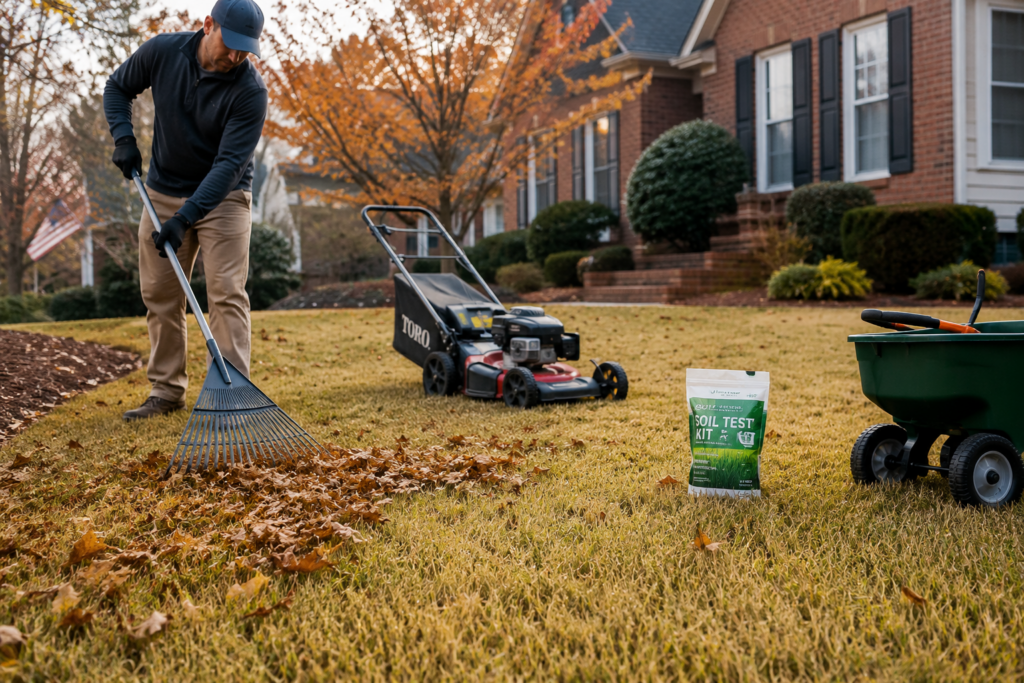
September–November Tasks That Set the Stage
Fall care should help Bermuda store energy, protect its crowns, and enter dormancy cleanly. It should not push soft new growth just before frost.
Use this checklist:
- Base fertilizer on a soil test. Do not apply nitrogen by habit. NC State recommends no more than ½ pound of nitrogen per 1,000 square feet in September, or within four weeks of the expected first frost. Stop fertilizing once frost approaches.
- Add potassium only when appropriate. Potassium can improve cold tolerance, but more is not always better. When needed, NC State recommends 1 pound of potash per 1,000 square feet four to six weeks before the expected frost. That equals about 1½ pounds of 0-0-60 product.
- Raise the mower slightly. In Charlotte’s Piedmont region, raise your normal mowing height by about ½ inch in mid-to-late September. You are protecting the crowns, not letting the lawn grow wild.
- Leave heavy thatch work for spring. Do not power rake Bermuda as it is preparing for dormancy. If thatch is thicker than ½ inch, NC State recommends removing it after full green-up, usually in late May, when the lawn can recover.
- Keep leaves off the lawn. Mulch a light layer into small pieces. Bag or remove heavier piles before they become wet and matted.
You can download the printable Fall Prep Checklist at the end of this guide and keep it with your lawn equipment.
Winter Maintenance Do’s and Don’ts
Dormant Bermuda needs less work, but it should not be ignored. A few simple checks can protect the crowns and reduce problems before spring green-up.
Do’s
- Water only during serious dry spells. Check the soil about 2 inches deep. If it is dry and powdery, water lightly in the morning on a day that will remain above freezing. Dormant grass needs far less water than actively growing Bermuda.
- Remove leaves and debris. Pick up branches after storms and clear wet, matted leaves. Heavy debris blocks light, holds moisture, and can smother the turf beneath it.
- Watch for winter weeds. Hand-pull small patches before they spread. Existing poa annua, chickweed, and henbit will not be killed by pre-emergent.
- Use herbicides carefully. Spot-treat only with a product labeled for the weed, Bermuda grass, and its current stage of dormancy. Some treatments are safe only when Bermuda is fully dormant.
Don’ts
- Do not scalp dormant Bermuda. Cutting too low exposes the crowns to cold, wind, and moisture loss. Save the low first mow for the proper spring transition.
- Do not apply nitrogen. Fertilizer will not wake up dormant roots properly. It may encourage weak growth during a warm spell that the next frost can damage.
- Do not walk on frozen turf. Foot traffic can crush frost-covered leaves and leave visible tracks after the lawn begins to green up.
- Do not guess about lime or fertilizer. Winter is a good time to submit a soil sample. The official North Carolina testing service provides pH and nutrient recommendations based on the needs of your lawn.
Spring Transition: When to Stop Pre-Emergent and Wake Up Your Lawn
Timing the First Spring Mow
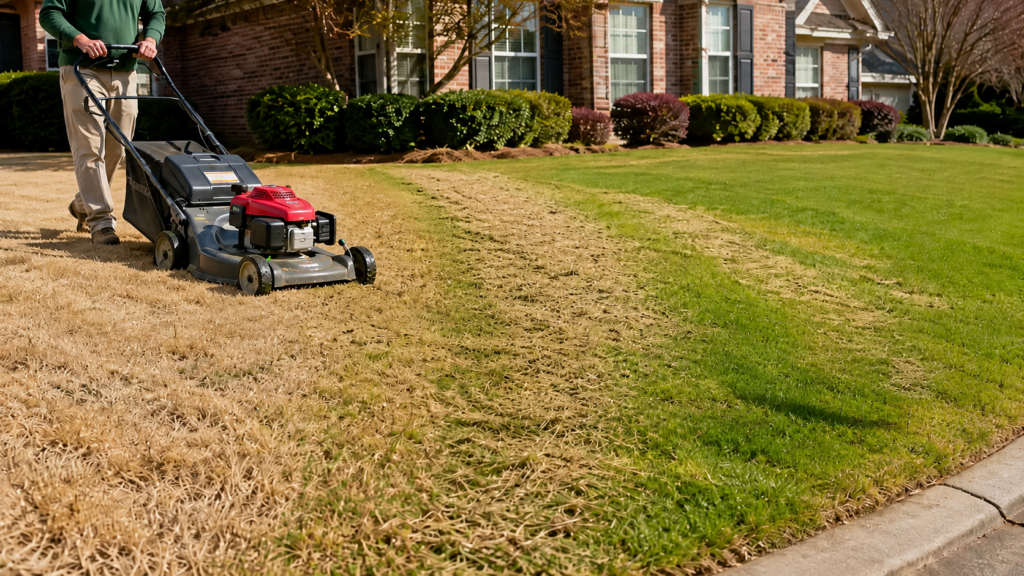
Watch the grass, not a fixed April date.
When Bermuda first begins to turn green, lower the mower enough to remove the brown winter growth without cutting into the crowns. NC State recommends setting the mower as low as possiblewithout scalping the lawn.
For most homeowner lawns:
- Use a sharp rotary or reel mower.
- Lower the height gradually if the dormant growth is heavy.
- Remove thick or clumped clippings.
- Avoid cutting into uneven soil or exposed crowns.
The goal is to clear away excess dormant tissue so sunlight can reach the new growth. It is not to shave the lawn down to bare soil.
When to Stop Pre-Emergent Applications
Your main spring pre-emergent should normally go down between mid-February and early March in North Carolina.
Do not make another application simply because April arrives. Check:
- The product’s residual period
- The maximum yearly rate
- Whether a split application is allowed
- The waiting period before seeding or sprigging
Most pre-emergents can prevent Bermuda seed from germinating. Follow the product label if you plan to repair bare areas in late spring.
Wait to apply nitrogen until the Bermuda is fully green and actively growing. NC State recommends ½ to 1 pound of nitrogen per 1,000 square feet several weeks after full green-up, ideally based on a soil test.
Feeding too early helps weeds more than dormant Bermuda.
Common Winter Weeds in Charlotte and How Pre-Emergent Stops Them
The Usual Suspects
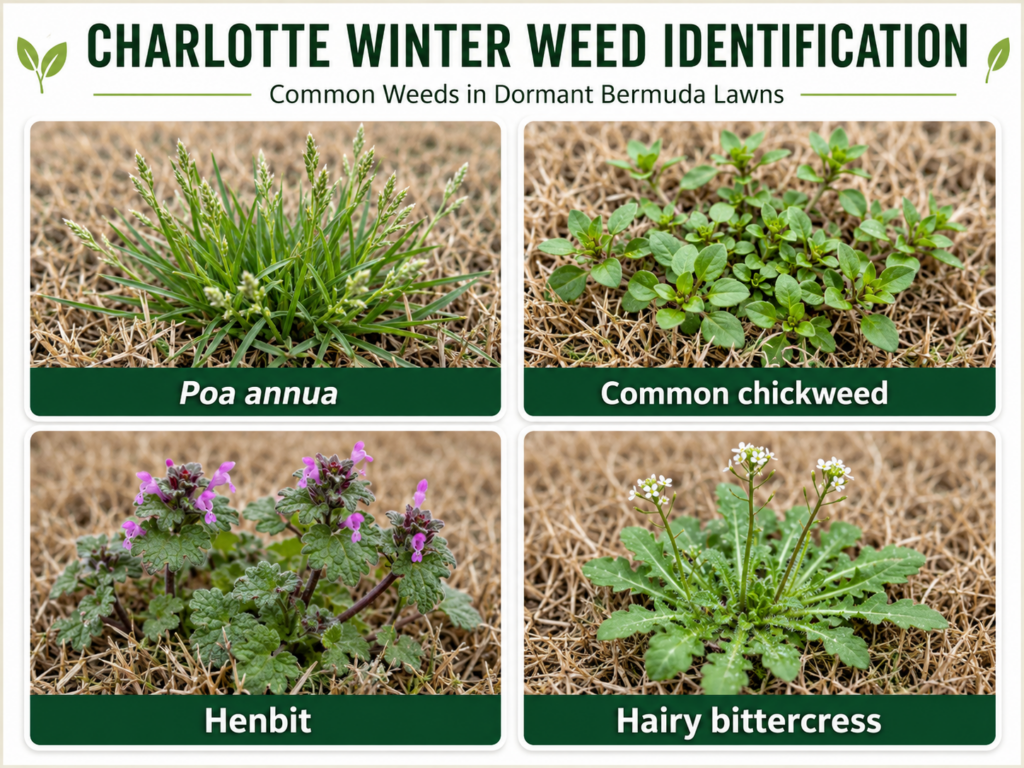
Dormant Bermuda makes winter weeds easy to spot. The lawn turns tan while the weeds stay bright green.
The most common problems include:
- Poa annua: A light-green, clumping grass that produces small white seed heads. Most poa annua germinates during cool fall conditions, so prevention usually begins before winter. Established outbreaks may require professional poa annua control rather than another pre-emergent application.
- Common chickweed: A low-growing broadleaf weed that spreads into thick mats. Look for small white flowers and soft stems in cool, damp areas.
- Henbit: Recognized by its purple flowers and square stems. It often appears along lawn edges and in thin Bermuda by late winter.
- Hairy bittercress: A small weed with white flowers and seed pods that burst when touched. One plant can spread seed across a surprising amount of lawn.
How the Pre-Emergent Barrier Works
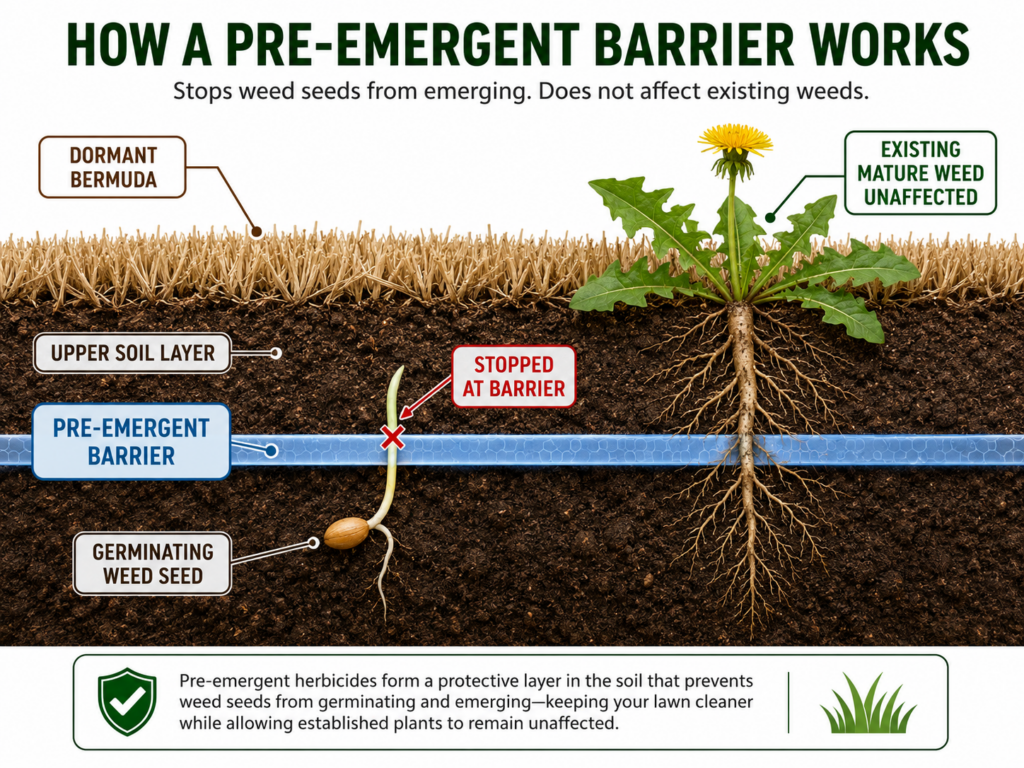
Pre-emergent settles into the upper layer of soil and forms a protective barrier.
As weed seeds begin to germinate, the herbicide stops their young roots and shoots from developing normally. The seedlings die before they become visible.
It does not kill weeds that are already growing.
That is why timing matters. Put the barrier down before germination, water it in as directed, and avoid disturbing the soil afterward.
The downloadable checklist includes a quick Weed ID card to help you identify these common Charlotte winter weeds.
Expert Q&A: Your Top Winter Bermuda Questions Answered
Real Questions From Charlotte Homeowners
Frequently Asked Questions
Can I overseed Bermuda with ryegrass and still use pre-emergent?
Usually, no. Pre-emergent cannot tell the difference between a weed seed and the ryegrass seed you want to grow. Choose winter color or stronger weed prevention, then follow the seeding interval on your product label. Overseeded ryegrass can also compete with Bermuda during spring green-up.
Dithiopyr can also control very young crabgrass after it emerges. It will not remove established poa annua, chickweed, or henbit already growing in the lawn.
What if I miss the February application window?
Check the soil temperature before giving up. An early-March application may still prevent later-germinating crabgrass.
A jar test can reveal physical mixing problems, but it does not make an unapproved mixture safe or legal. I would rather make two correct applications than one risky cocktail.
Can I mix pre-emergent with a post-emergent?
Only if both product labels allow the combination for the intended application site, turf species, and timing.
Estimate its remaining control from the product, rate, application date, rainfall, irrigation, and soil disturbance. Watch for crabgrass breakthroughs, but do not automatically reapply. Check the label’s yearly maximum and whether sequential applications are allowed.
How do I know whether the barrier still works in April?
You cannot see the barrier.
DIY makes sense when you can measure the lawn, calibrate your equipment, monitor soil temperature, and follow the label exactly. Professional treatment becomes valuable when weed identification, timing, product selection, or accurate coverage feels uncertain. After 20 years of working on Charlotte Bermuda lawns, I have found that the product is rarely the hardest part. Getting the right material down evenly at the right time is what separates good control from another weedy spring.
Is professional treatment better than DIY?
Both can work.
Charlotte Bermuda Winter Prep Checklist
Download the printable fall prep checklist and winter weed ID card to keep your Bermuda lawn on track through winter and into spring.
Download ChecklistNeed Help With Your Lawn?
Get professional lawn care built around your property, grass type, and seasonal needs.
Get a Free Quote