You want a thicker, greener lawn. The confusing part is deciding which fertilizer can actually help you get there.
One bottle promises fast color from a liquid spray. A bag of granules promises steady feeding over several weeks. Online advice often reduces the choice to “fast liquid” versus “slow granular,” but that leaves out the most important detail:
Liquid and granular describe how fertilizer is delivered. They do not automatically tell you how quickly its nutrients release or how the grass absorbs them.
A liquid product can contain quick- or slowly available nitrogen. Granular fertilizer can also be quick-release, controlled-release, or a blend of both. Urea, one of the most common nitrogen sources, can be applied in either form. The formulation, nutrient rate, grass type, soil condition, weather, and timing matter more than whether the product begins in a bottle or bag.
NC State Extension likewise classifies nitrogen by its release characteristics and notes that quick- and slow-release sources may be available in different application forms.
This guide compares liquid and granular lawn fertilizer by speed, longevity, cost, equipment, burn risk, and environmental impact. More importantly, it explains how the answer changes for tall fescue, Bermuda, and Zoysia lawns in the Charlotte area.
For a wider explanation of fertilizer labels and nutrients, read our complete guide to lawn fertilizer.
Liquid vs. Granular Fertilizer: The Quick Answer
Neither form is automatically better for every lawn.
Liquid fertilizer is useful when nutrients or compatible treatments need to be distributed in solution. Depending on the product, it may provide a relatively fast response or deliver a carefully measured seasonal treatment.
Granular fertilizer is useful when nutrients need to be spread across the soil surface with a broadcast or drop spreader. Many controlled-release products come in granular form, but some granules release nutrients quickly.
For many Charlotte lawns, the right program may use both forms at different times. Other visits may focus on weeds, disease, insects, iron, potassium, lime, or soil conditioning instead of fertilizer.
The goal is to choose the right treatment for the grass, soil, season, and current problem.
First, Separate Fertilizer Form From Nutrient Release
Two different decisions are often confused.
Physical Form
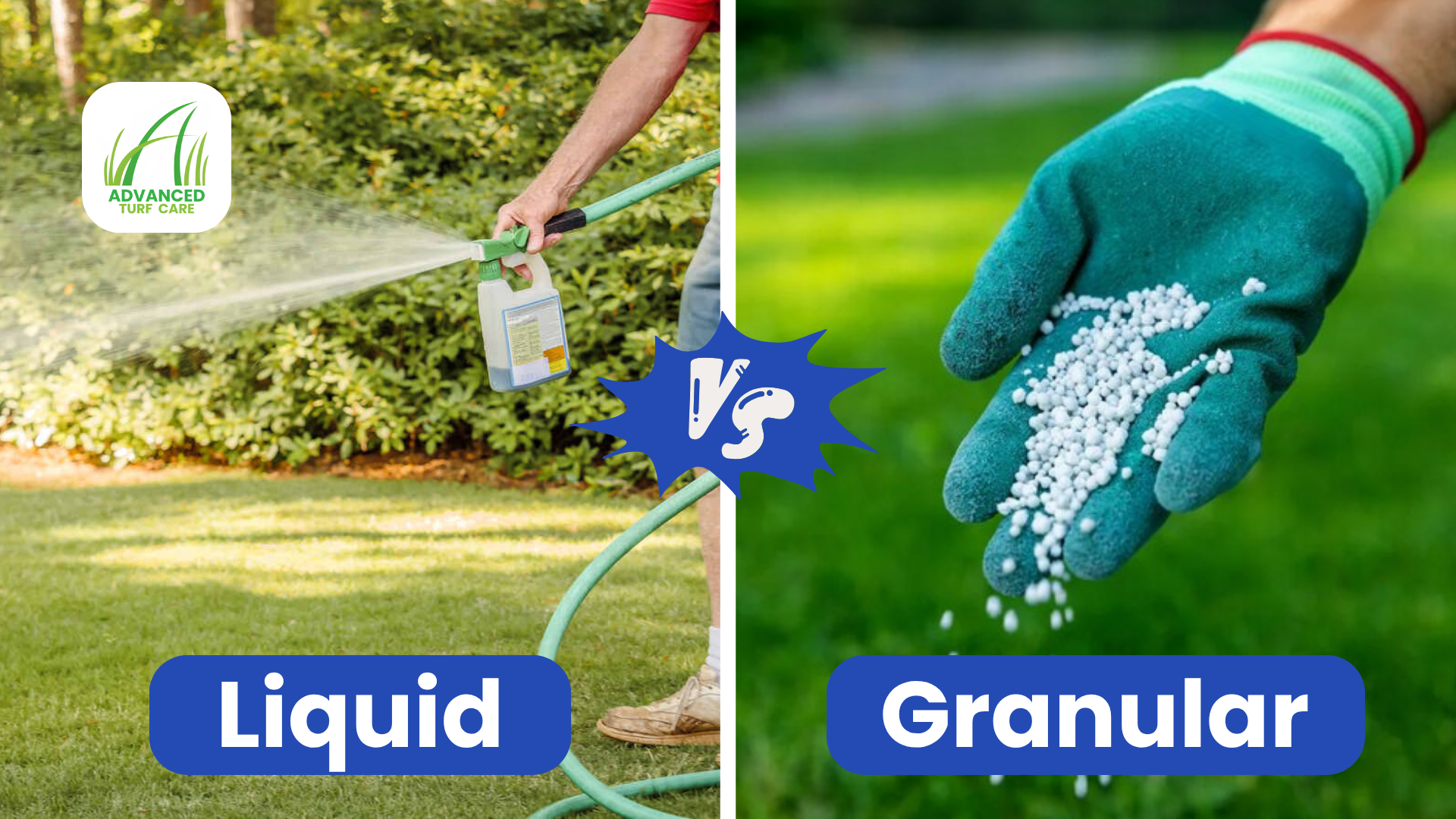
- Liquid fertilizer is dissolved or suspended in water and applied through a hose-end, backpack, or powered sprayer.
- Granular fertilizer consists of dry particles applied with a broadcast or drop spreader.
Nutrient-Release Type
- Quick-release fertilizer supplies nitrogen that becomes available rapidly. It may create a faster response, but excessive rates can increase growth, burn potential, or nutrient loss.
- Slow- or controlled-release fertilizer supplies nitrogen over a longer period. Its release may depend on a coating, moisture, temperature, or microbial activity.
- Blended fertilizer combines quick- and slowly available nitrogen sources.
Do not judge a fertilizer only by its container. Read the label for the nutrient analysis, percentage of slowly available nitrogen, application rate, watering instructions, and restrictions for heat or stressed turf.
How Liquid Fertilizer Works
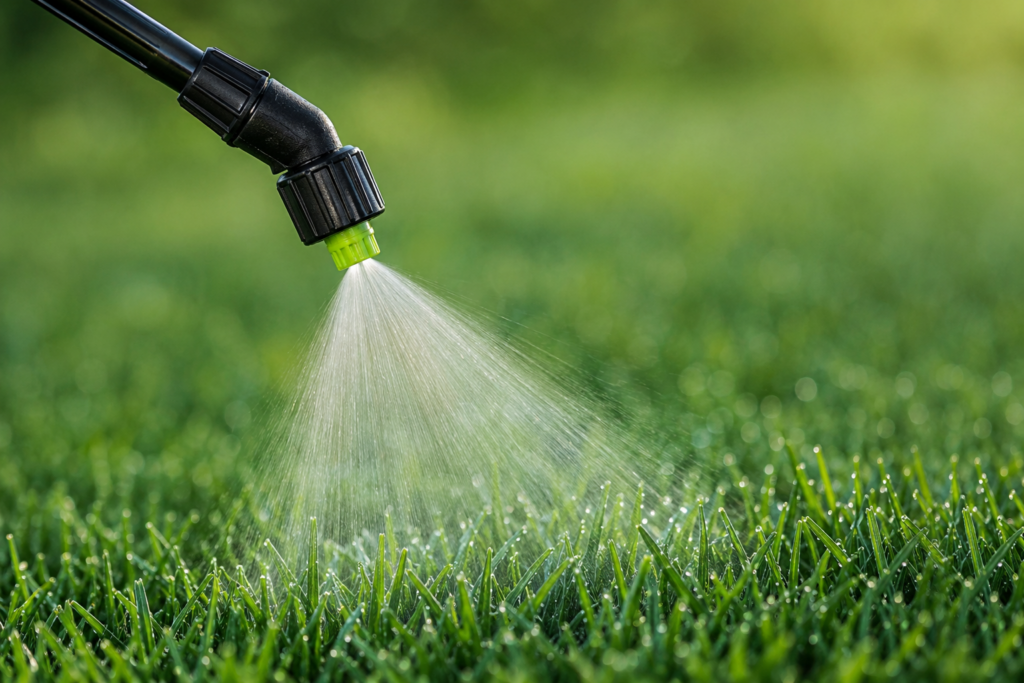
Liquid fertilizer delivers nutrients in a solution or suspension. Depending on its formulation and application volume, nutrients may be absorbed through the grass leaves, move into the soil for root uptake, or use both pathways.
Not every liquid treatment is simply a “foliar feed.” Some target a fast color response; others move nutrients toward the root zone or accompany another label-compatible treatment.
Advantages of Liquid Fertilizer
Uniform coverage when calibrated correctly: A properly functioning sprayer can cover curves, narrow strips, and irregular lawn areas evenly.
Flexible treatment options: Liquid applications may deliver nitrogen, iron, potassium, micronutrients, or other compatible lawn treatments selected for a particular need.
Potential for a faster response: Soluble nutrients may improve color relatively quickly when the lawn has a correctable deficiency and is actively growing.
Precise professional application: A calibrated system can deliver a measured volume over a known turf area.
Limitations of Liquid Fertilizer
Mixing errors matter: Increasing the concentration does not improve the treatment. It raises the risk of salt injury and excessive growth.
Sprayer calibration is essential: Nozzle output, pressure, walking speed, spray width, and overlap determine how much product reaches the turf.
Weather affects the application: Wind can cause drift, while heat, drought stress, saturated soil, or heavy rain can make the timing unsuitable.
Fast color is not a complete diagnosis: Darker grass does not prove that pH, compaction, drainage, disease, or root problems have been corrected.
Liquid fertilizer is a useful delivery method, but it is not a shortcut around choosing the correct nutrient and timing.
How Granular Fertilizer Works
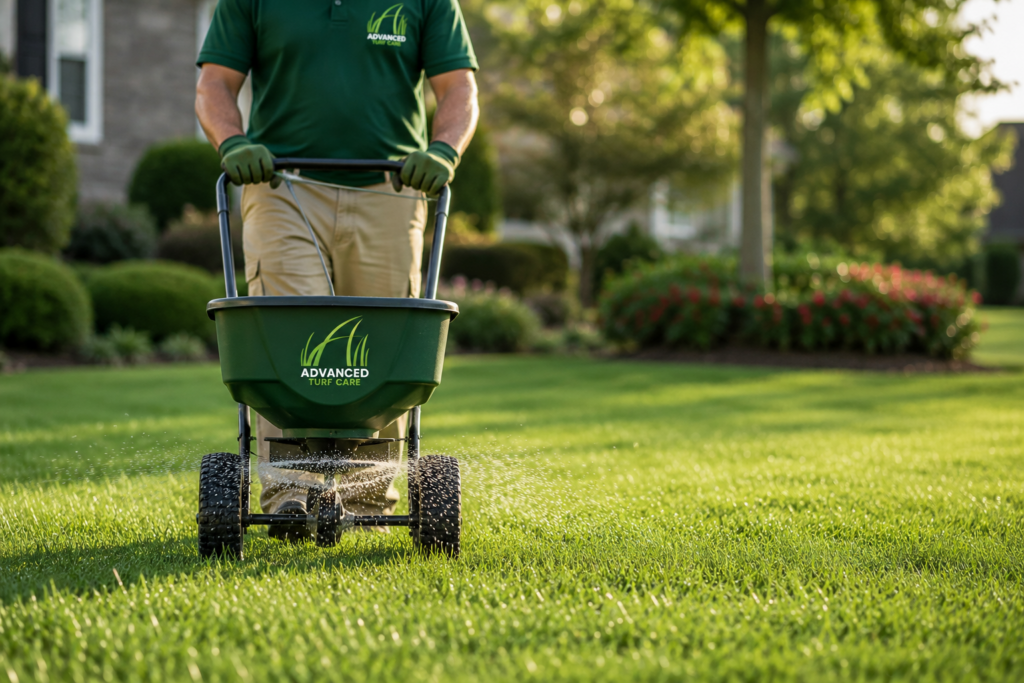
Granular fertilizer is spread as dry particles. Moisture then dissolves the material or begins the release process, depending on the product.
Some granules release nutrients quickly. Others are coated or formulated for gradual release. Many products combine both.
Advantages of Granular Fertilizer
Convenient application equipment: A broadcast spreader can cover an average residential lawn efficiently.
Many controlled-release options: Granular products are commonly used when gradual nutrient availability is desired.
Visible application pattern: The operator can divide the lawn into sections and use crossing passes for more even coverage.
Straightforward dry storage: Properly sealed granules are easy to store as long as they remain dry.
Limitations of Granular Fertilizer
Uneven spreading causes stripes: Missed areas, overlap, changing walking speed, or an incorrect spreader setting can create patchy color.
Spills create concentrated damage: A leaking spreader or tipped bag can place a damaging amount of fertilizer in one spot.
Watering requirements vary: Many soil-applied granules need irrigation, but the correct amount must come from the label.
Hard surfaces must be cleaned: Fertilizer left on sidewalks, driveways, or curbs can wash into storm drains.
Granular fertilizer can provide excellent results, but it is not foolproof.
Liquid vs. Granular Fertilizer Comparison
| Factor | Liquid fertilizer | Granular fertilizer |
|---|---|---|
| Application form | Dissolved or suspended in water | Dry particles |
| Equipment | Hose-end, backpack, or powered sprayer | Broadcast or drop spreader |
| Nutrient release | May be quick, slow, or blended | May be quick, slow, or blended |
| Uptake | May occur through foliage, roots, or both | Nutrients generally enter the soil for root uptake |
| Main coverage risks | Drift, missed strips, excessive overlap, poor nozzle output | Missed strips, overlap, spills, incorrect spreader setting |
| Watering | Depends on product and treatment objective | Often needs watering in; follow the label |
| Visible response | Can be fast with soluble nutrients | Can be fast or gradual |
| Burn risk | Rises with excessive concentration, poor timing, or stressed turf | Rises with excessive rates, spills, uneven coverage, or improper watering |
| Best use | Determined by nutrient source and treatment goal | Determined by nutrient source and treatment goal |
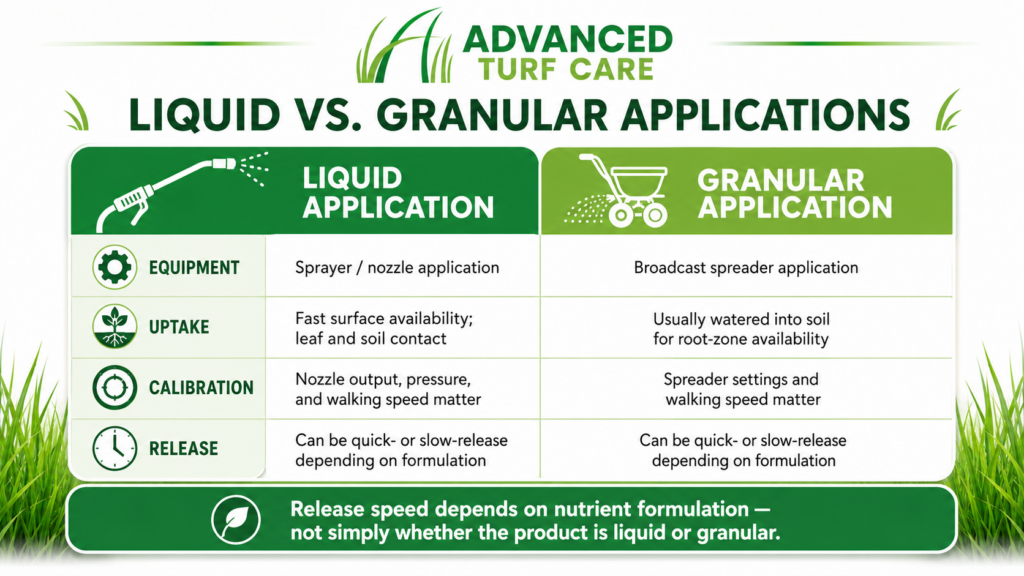
There is no honest one-word winner. Products with different packaging may behave similarly when they use comparable nutrient sources.
Which Fertilizer Works Faster and Lasts Longer?
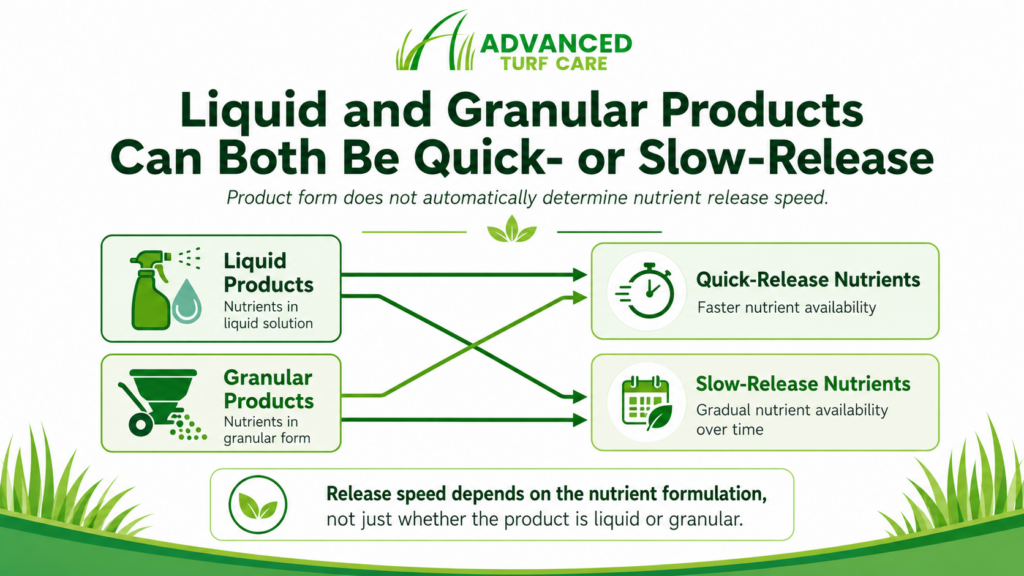
Liquid fertilizer often appears faster because soluble nutrients are already dispersed in water. When the grass can use them, color may improve sooner than it would with a product that must first dissolve or release through a coating.
But speed is not always the right goal.
A rapid nitrogen response can create dark color and extra blade growth. That may help when the turf genuinely needs nitrogen during an appropriate growth period. It may be counterproductive when the lawn is drought-stressed, entering a high-disease period, or already receiving enough nitrogen.
Granular fertilizer can also act quickly when it contains soluble nitrogen. A liquid product containing slowly available nitrogen may last longer than expected.
Controlled-release sources usually feed over a longer period than fully soluble quick-release sources. Duration changes with temperature, moisture, microbial activity, coating type, rainfall, and growth rate.
When comparing products, look beyond “liquid” or “granular” and check:
- The nitrogen percentage.
- The percentage that is slowly available.
- The application rate per 1,000 square feet.
- The grass species listed on the label.
- Seasonal or temperature restrictions.
- Watering directions.
Evaluate the lawn by density, growth, disease pressure, and seasonal performance—not color alone.
Which Option Costs Less?
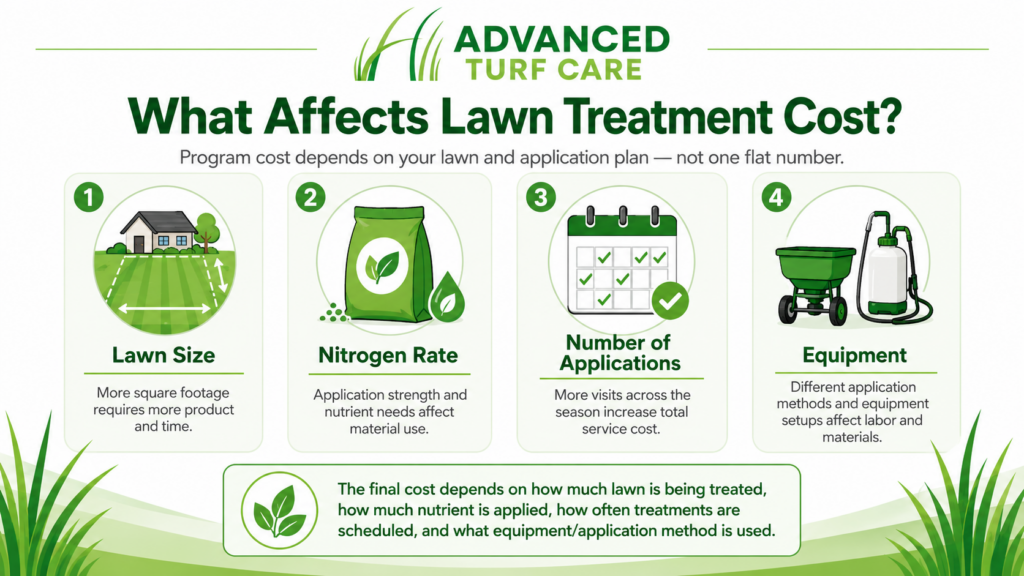
Container price is a poor way to compare fertilizer.
The real cost depends on how much nutrient reaches the maintained turf area, not the size of the container.
Cost is shaped by:
- Turf square footage
- Fertilizer analysis
- Intended nitrogen rate
- Quick- versus controlled-release content
- Number of applications
- Added iron, potassium, or micronutrients
- Equipment and cleanup time
- Product lost through poor calibration
- Damage caused by overapplication
The first number in the fertilizer analysis is the nitrogen percentage by weight. A 20-pound bag labeled 20-0-10 contains four pounds of nitrogen in the full bag. That does not mean all four pounds belong on one lawn or in one application.
Measure the grass instead of using the property’s total lot size. For the calculation process, read how much fertilizer your lawn needs.
Advanced Turf Care also bases quotes on maintained turf square footage rather than counting the house, driveway, wooded areas, beds, and patios as treatable lawn.
Correct Application Matters More Than the Format
A suitable fertilizer can still fail when it is applied unevenly.
Applying Granular Fertilizer
Use a clean spreader with a working hopper and impeller. The setting printed on the bag is a starting reference, not a guarantee across every spreader model.
For even coverage:
- Measure the turf area.
- Calculate the required product.
- Divide the lawn into sections.
- Apply half the rate in one direction.
- Apply the other half at a right angle.
- Maintain a consistent pace.
- Close the hopper before stopping or turning.
- Sweep granules from pavement back onto the lawn.
- Water only as the label directs.
Avoid broadcasting fertilizer by hand because uniform coverage is difficult.
Applying Liquid Fertilizer
Check the nozzle pattern, sprayer output, pressure, walking speed, and treatment width before mixing the product.
Use a dedicated measuring container and follow the label’s mixing order. Avoid windy conditions, maintain a consistent spray pattern, and rinse equipment as directed.
A stronger mix is not better; follow the labeled rate.
Fertilizer Burn: Is One Form Safer?
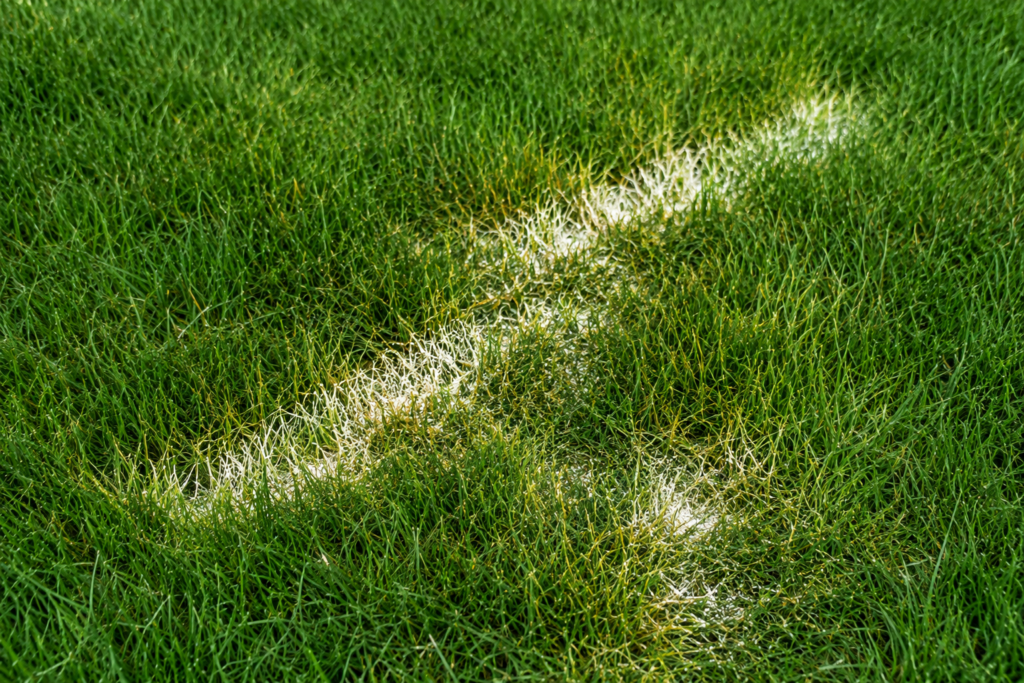
Both forms can burn grass.
Fertilizer burn commonly occurs when concentrated soluble salts draw moisture away from plant tissue or roots. It can follow excessive rates, a spill, overlapping passes, poor mixing, or application to stressed turf.
Liquid burn often follows over-concentration or uneven spraying. Granular burn often follows spills, leaks, excessive overlap, or incorrect watering.
Quick-release nitrogen generally carries more immediate burn potential than controlled-release nitrogen, regardless of physical form.
Reduce the risk by measuring the lawn, calculating the rate, calibrating equipment, cleaning spills immediately, and following the label. Avoid fertilizing severely wilted or drought-stressed turf, and do not apply immediately before a likely downpour.
When damage appears, do not add another product to “balance” the lawn. Identify what was used, how much was applied, and when.
Our guide to whether fertilizer burns grass explains the signs and next steps.
Environmental Impact and Runoff
Neither liquid nor granular fertilizer is automatically greener.
Risk depends on the nutrient source, rate, placement, soil, slope, irrigation, and rainfall. Controlled-release fertilizer can still enter waterways when overapplied or left on hard surfaces.
Responsible use means:
- Applying only the nutrients the turf needs
- Keeping fertilizer out of storm drains and drainage channels
- Sweeping paved surfaces
- Avoiding saturated or severely compacted soil
- Avoiding excessive irrigation
- Maintaining vegetated buffers near water
- Returning grass clippings when practical
- Testing the soil before adding unnecessary nutrients
Phosphorus is essential, but established turf may not need more when soil levels are already adequate.
Read about phosphorus-free lawn fertilizer before choosing a high-phosphorus product simply because it is labeled “complete.”
Why Soil Testing Matters More Than Liquid vs. Granular
Yellow grass does not always need nitrogen.
Incorrect pH, compacted soil, poor drainage, drought, excessive moisture, disease, insects, root injury, and iron deficiency can create similar symptoms. Fertilizer may be wasted—or may increase stress—when the real cause is not a nutrient shortage.
A soil test helps evaluate pH and the need for nutrients such as phosphorus and potassium. NC State recommends soil testing because lime and nutrient requirements vary considerably between properties.
Charlotte clay can become compacted and restrict air, water, and roots. Fertilizer cannot physically correct compaction; aeration, soil conditioning, or irrigation changes may also be needed.
Learn more in the importance of soil testing your lawn.
Charlotte Fertilizer Timing Depends on the Grass
Charlotte’s transition-zone climate supports both cool-season and warm-season grasses. That makes one-size-fits-all national calendars especially unreliable.
Tall Fescue
Tall fescue is a cool-season grass. It performs strongly during cooler periods and faces significant heat, humidity, and disease pressure during Charlotte summers.
NC State’s basic tall fescue guidance emphasizes fall fertilization, including applications around mid-September and November, while using more cautious rates during warmer periods.
A fescue plan may need to coordinate:
- Fall fertilization and overseeding
- Winter color and weed management
- Spring pre-emergent timing
- Brown patch protection
- Iron, potassium, or soil support
- Reduced growth pressure during summer stress
This is also why a winterizer should not be treated as just another bag of regular fertilizer.
Read winterizer vs. regular fertilizer before choosing a late-season product by marketing language alone.
Bermuda Grass
Bermuda is a warm-season grass. Its strongest growth and nutrient demand occur after spring green-up and through warm weather.
NC State’s Bermuda maintenance calendar places its more active fertilization during the growing season and calls for more caution near the end of the season.
A Bermuda program may coordinate fertilizer with spring green-up, crabgrass prevention, summer weed control, insect monitoring, potassium, and fall pre-emergent treatment.
Feeding dormant Bermuda on a fescue schedule wastes product and misses its active growth period.
Zoysia Grass
Zoysia is also warm-season turf, but it generally should not be treated as though it has the same fertility demand as aggressively maintained Bermuda.
NC State recommends basing Zoysia nutrients on soil testing, beginning fertilization after green-up, and avoiding excessive annual nitrogen.
Too much nitrogen can create unnecessary mowing, thatch, or disease pressure without building a healthier lawn. Correct grass identification is therefore essential before choosing either liquid or granular fertilizer.
Should You Use Both?
A program that uses liquid and granular products at different times can make sense. The benefit is flexibility, not the oversimplified idea that granular “builds roots” while liquid only “makes grass green.”
A controlled-release granular fertilizer may provide gradual feeding during active growth. A liquid application may deliver iron, soluble nutrients, or another compatible treatment.
At another visit, the lawn may need weed control, fungicide, insect treatment, soil conditioner, or no fertilizer at all.
The challenge is tracking the combined nutrient total. Stacking products because the lawn still looks pale can exceed the intended rate.
A responsible program considers:
- Total nitrogen already applied
- Quick- versus controlled-release nitrogen
- Grass type and growth stage
- Soil-test findings
- Moisture and weather
- Disease or insect pressure
- Previous and upcoming treatments
- Overseeding or dormancy timing
- Product-label compatibility
Frequently Asked Questions
Do not automatically apply them together or close together. Count the nutrients from both products and follow every label. Never mix products unless their labels permit it and compatibility is confirmed.
Can Liquid and Granular Fertilizer Be Used During the Same Season?
Yes. Many programs use different formulations during the year.
Granular products can respond quickly when they contain soluble nitrogen.
Does Liquid Fertilizer Always Work Faster?
No. Many soluble liquids can produce a relatively fast response, but liquid products can also contain slowly available nitrogen.
Follow the label instead of using one watering rule for every bag. Avoid relying on uncertain rainfall, especially when heavy rain could move fertilizer away from the lawn.
Does Granular Fertilizer Always Need Watering?
Many granular products need to be watered into the soil, but instructions vary.
A starter fertilizer may be appropriate, but phosphorus should not be added automatically when the soil already has enough. New seed also depends on seed-to-soil contact and moisture, while sod needs correct root-zone watering.
Which Form Is Better for New Seed or Sod?
Use the guidance for the grass species and establishment method.
Many organic sources release nutrients gradually, but their release changes with temperature and moisture. Some also supply phosphorus that the lawn may not need. Apply them at the labeled rate and count their nutrients in the annual total.
Is Organic Granular Fertilizer Safer?
Organic does not mean risk-free.
A soluble nitrogen or iron treatment may improve color when a deficiency is the cause. Fertilizer may not help when the real issue is heat stress, disease, compaction, root damage, incorrect pH, or too much water.
What Gives the Fastest Green-Up?
First diagnose why the lawn is pale.
Do not use the full lot size or guess from lawn color.
How Much Fertilizer Should I Use?
Measure the maintained turf area, identify the recommended nutrient rate for the grass and season, and calculate product from the fertilizer analysis.
Final Recommendation: Choose the Right Program, Not Just the Form
Instead of asking only whether liquid or granular is better, ask:
- What grass is growing here?
- What nutrients does it need?
- Is it actively growing or under stress?
- Is the pH suitable?
- Is the product quick-release, controlled-release, or blended?
- How much nitrogen will it deliver?
- What has already been applied?
- Is fertilizer actually the solution?
Liquid and granular fertilizers can both perform well. Both can also be wasted or damaging when applied to the wrong grass, at the wrong rate, or during the wrong season.
Advanced Turf Care builds separate programs for Charlotte-area tall fescue and warm-season Bermuda and Zoysia lawns.
Its warm-season program includes eight seasonal applications, while the Fescue Greenskeeper program includes ten. Those are not identical fertilizer visits. Depending on the lawn and season, treatments may include fertilization, pre-emergent and post-emergent weed control, disease support, insect control, iron, potassium, lime, or soil conditioner.
Founder Andrew Powell brings more than 20 years of hands-on lawn care and horticultural experience, and Advanced Turf Care has served Greater Charlotte since 2019.
Ready to stop comparing bags and start with what your lawn actually needs?
Request your lawn fertilization evaluation or call Advanced Turf Care at (704) 800-5955.
Give Your Lawn the Nutrition It Needs
Get a fertilization program designed for healthier color, stronger growth, and better seasonal performance.
Explore Fertilization