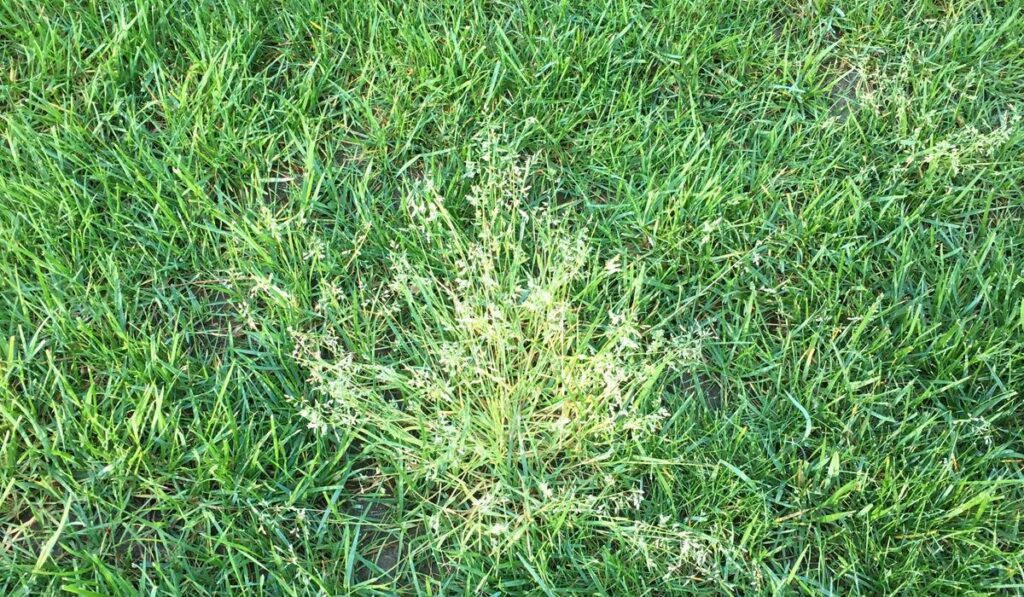
You’ve spent every Saturday this summer dragging a hose across a lawn that still looks thin, brown, and tired. North Carolina’s brutal July heat and heavy clay soils can turn even a well-cared-for lawn into a weedy, compacted mess.
The good news? The fix isn’t more water or a miracle product from the hardware store. It’s seeding the right way, at the right time, with the right grass.
This guide is built for North Carolina homeowners, not recycled from a national lawn care website. Here’s what you’ll learn:
- Exactly when to seed for your region (Coastal, Piedmont, or Mountains)
- How to choose a grass that won’t melt in August
- The step-by-step seeding process NC State Extension specialists recommend
- A month-by-month calendar you can print and hang in the garage
By the end, you’ll have a clear plan to turn your struggling yard into a thick, resilient lawn. One that can handle our summers, our clay, and your kids’ weekend soccer games.
No guesswork. No wasted money. Just a lawn you’ll be proud of.
Understanding North Carolina’s Climate and Grass Types

The Transition Zone Challenge
North Carolina sits right in the turfgrass transition zone. That means neither cool-season nor warm-season grasses feel perfectly at home here year-round.
Summers get too hot for Kentucky bluegrass to survive without heavy watering. Winters get cold enough to knock back Bermuda and zoysia. Your grass choice has to be a strategic compromise, and it starts with knowing your region.
NC State Extension’s TurfFiles website and its Carolina Lawns publication are the go-to resources for matching grass types to North Carolina’s climate zones.
Cool-Season vs. Warm-Season Grasses: What Works Where
- Cool-season grasses (tall fescue, Kentucky bluegrass, fine fescue): Grow most actively in spring and fall. Tall fescue is the workhorse for the Piedmont and Mountains thanks to its heat tolerance and deep roots. Kentucky bluegrass is less common here due to disease pressure and high water needs.
- Warm-season grasses (Bermuda, zoysia, centipede, St. Augustine): Thrive in summer heat and go dormant (brown) after frost. Bermuda is the top pick for full-sun Coastal and southern Piedmont lawns. Zoysia handles shade better. Centipede works well in acidic, sandy soils in the eastern part of the state.
Stuck in the Piedmont and can’t decide? Tall fescue is the safest bet. It stays green through winter and, with proper care, holds up through summer.
How to Choose Based on Your Yard’s Conditions
Answer these three questions before you buy a single bag of seed.
- Sunlight. Full sun (8+ hours): Bermuda, zoysia, or tall fescue. Partial shade (4–6 hours): tall fescue, fine fescue, or zoysia. Heavy shade: a shade-tolerant fine fescue mix or a groundcover alternative.
- Traffic. Kids and pets running around? Tall fescue or Bermuda hold up best to wear. Skip centipede and St. Augustine in high-traffic areas.
- Maintenance level. Want low-input? Centipede or established zoysia need less mowing and fertilizer. Tall fescue needs more attention but rewards you with year-round green.
Match your sunlight, traffic, and maintenance answers together, and you’ll land on the right grass type in under a minute. For more depth, check out our guide on best grass seeds in NC. It has an interactive tool that helps to find the best grass for your yard.
Best Time to Seed in NC: A Seasonal Guide
The Golden Window for Tall Fescue: September 1 – October 15
Fall is the undisputed champion for seeding in North Carolina. Soil is still warm from summer, which speeds germination. Air temperatures are cooling, which reduces stress on young seedlings.
The window is tight. Aim to seed between September 1 and October 15 in the Piedmont and Mountains. Coastal areas can push into late October.
Seed too early, and you risk heat stress. Seed too late, and seedlings won’t mature before frost hits.
Grab a soil thermometer. When soil at a 2-inch depth reads 60–70°F, you’re in the sweet spot. NC State’s TurfFiles website often posts soil temperature maps to help you track it.
Warm-Season Seeding: Late Spring (May–June)
Bermuda, zoysia, and centipede need soil temperatures of 65–70°F to germinate. That typically happens from mid-May through June across the state.
Never seed warm-season grasses in fall. They won’t establish before winter dormancy hits, and they’ll likely die. NC State Extension’s turfgrass establishment calendar lays out these soil temperature thresholds region by region.
Regional Timing Adjustments
- Mountains: Cooler temperatures shorten the fall window. Seed tall fescue by mid-September. Warm-season grasses are rarely used here due to short growing seasons.
- Piedmont: The classic fall window applies. Spring seeding of tall fescue is risky, but possible if you irrigate heavily and accept some summer loss.
- Coastal Plain: Fall seeding can extend into late October. Warm-season seeding can start as early as late April in southern coastal counties.
NC Region-Specific Seeding Calendar: A Month-by-Month Visual Guide
This calendar turns generic advice into a personalized, actionable plan. Print it, hang it in the garage, and check off tasks as you go through the year.
Tasks marked with an asterisk (*) are critical for seeding success. Adjust dates slightly based on your local weather and soil temperature.
Coastal Plain Calendar
| Month | Tasks |
|---|---|
| January–February | Dormant season. Plan your renovation and order a soil test kit from your county extension office. |
| March | Soil test sampling. Apply lime if the test calls for it. Do not seed. |
| April | Core aerate if soil isn’t too wet. Late April: start soil prep for warm-season seeding. |
| May | *Seed Bermuda, zoysia, or centipede once soil hits 65°F. Water lightly, 3–4 times daily. |
| June | Keep up light, frequent watering. Apply starter fertilizer if you haven’t already. First mow once grass reaches 3 inches. |
| July–August | Mow established lawns weekly. Water deeply, 1–2 times per week. Do not seed. |
| September | If you have a warm-season lawn, skip overseeding with fescue, stick to one grass type. If you have fescue, this is your seeding month. |
| October | *Prime tall fescue window. Aerate, seed, top-dress, and start your watering regimen. |
| November | Final mow of fescue at 3 inches. Cut back watering as temps drop. |
| December | Dormant. Clean and store your equipment. |
Piedmont Calendar
| Month | Tasks |
|---|---|
| January–February | Order your soil test. Browse NC State’s recommended cultivar list while you wait for results. |
| March | Soil test sampling. Apply lime if needed. Do not seed. |
| April | Core aerate once the ground is dry enough. Dethatch if the layer exceeds ½ inch. This is also when liquid aeration becomes an option if compaction is heavy and core aeration alone isn’t cutting it. |
| May | Not a seeding month for fescue. If you must seed in spring, do it very early and plan to water all summer. |
| June | *Seed Bermuda or zoysia, if desired, once soil hits 65°F. Water frequently. |
| July–August | Maintain existing lawns. Mow fescue at 3.5 inches. Water deeply, not daily. |
| September | *Fescue seeding window opens. Aerate, seed, top-dress with compost, and start light watering. |
| October | *Keep seeding fescue through mid-October. Apply starter fertilizer at seeding. First mow once grass reaches 3.5 inches. |
| November | Final mow. Cut back watering. Apply a winterizer (low nitrogen, high potassium) to fescue after the last mow. |
| December | Dormant. Plan next year’s maintenance. |
Mountains Calendar
| Month | Tasks |
|---|---|
| January–February | Order your soil test. Research cold-tolerant fescue cultivars. |
| March | Soil test sampling. Apply lime. Do not seed. |
| April | Core aerate. Dethatch if needed. Prep the soil for seeding season. |
| May | Not a seeding month. Spot-treat weeds with a post-emergent if needed, but hold off if you’re seeding soon. |
| June–August | Maintain existing lawns. Mow fescue at 3 inches. Water during dry spells. |
| September | *Prime seeding window. Finish seeding by mid-September. Aerate, seed, top-dress, water. |
| October | Early October still works if soil temps hold warm. Apply starter fertilizer. First mow. |
| November | Final mow. Apply winterizer. Cut back watering. |
| December | Dormant. |
Download Your NC Lawn Seeding Calendar
Get the full three-page regional calendar for the Coastal Plain, Piedmont, and Mountains—ready to print and keep in the garage.
- Regional seeding windows
- Month-by-month lawn tasks
- Printable PDF format
Soil Preparation: Testing, Aeration, and Amendment
Why Soil Prep Is the Make-or-Break Step
You can buy the best seed in the world. But if it lands on compacted, acidic clay with no nutrients, you’ve just bought expensive bird food.
North Carolina’s heavy clay soils and naturally low pH mean skipping soil prep is the number one reason new lawns fail. NC State soil test lab data shows the majority of NC residential soil samples test below pH 6.0, which means lime is often needed for grass to thrive.
Step 1: Get a Soil Test (Do Not Skip This)
- Where: Pick up a soil test kit from your county Cooperative Extension office, or order one online from the NC Department of Agriculture & Consumer Services. Testing is free or low-cost from April to November.
- How: Collect 10–15 random cores from the lawn, 4 inches deep. Mix them in a clean bucket, remove debris, and fill the sample box. Mail it in.
- What you’ll learn: pH, phosphorus, potassium, and lime or fertilizer recommendations tailored to your grass type.
- Timing: Do this 4–6 weeks before your planned seeding date so you have time to apply amendments.
Never skip the soil test. In North Carolina, that’s the difference between a lawn that thrives and one that fails by July.
Step 2: Adjust pH with Lime (If Needed)
Most NC soils run acidic, typically pH 5.0–5.5. Tall fescue prefers 6.0–6.5. Bermuda and zoysia tolerate 5.8–6.5.
If your soil test calls for lime, apply pelletized dolomitic lime at the recommended rate. Work it into the top 4–6 inches with a rake or tiller, or water it in well. Lime takes months to fully react, so apply it as early as possible.
Never apply lime without a soil test first. Over-liming can tie up nutrients and create a bigger problem than the one you started with.
Step 3: Core Aeration, the Secret to Seed-to-Soil Contact
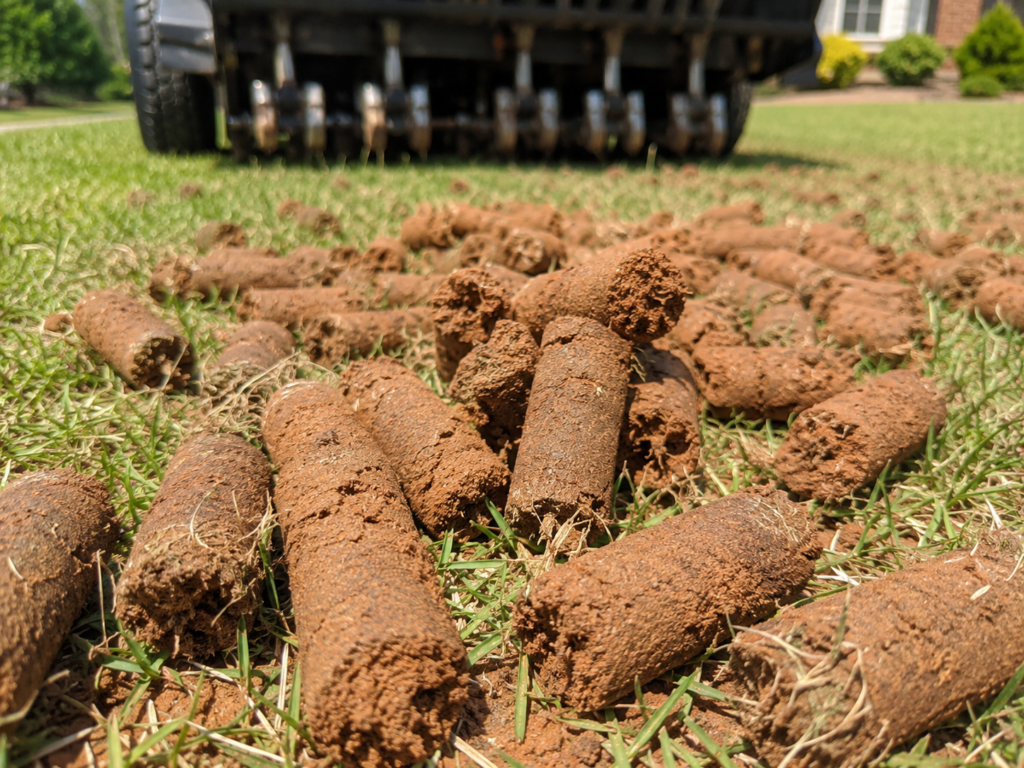
Compacted soil blocks roots from spreading and water from soaking in. Core aeration pulls small plugs of soil out of the ground, relieving that compaction and creating open pockets for seed to settle into.
- When: A day or two before seeding, when soil is slightly moist but not soggy.
- How: Rent a core aerator, the kind that pulls plugs rather than just spikes the soil, from a local equipment rental store. Make multiple passes, focusing on high-traffic zones.
- After aerating: Leave the plugs on the surface. They’ll break down naturally and add organic matter back into the soil.
Timing your aeration right matters as much as doing it. For a full breakdown of when to aerate based on your grass type and season, see when to aerate lawns in North Carolina.
If renting and running an aerator yourself sounds like more weekend than you’ve got, this is one step homeowners often hand off to a professional lawn care service for even, full-yard coverage.
Step 4: Dethatch If Necessary
Thatch is a layer of dead stems and roots sitting between the soil and the green grass above it. A thin layer, under ½ inch, is actually beneficial. Anything thicker blocks water, air, and seed from reaching the soil.
If your thatch layer exceeds ½ inch, run a dethatching rake or power rake over the lawn before you aerate. This matters most for older, established lawns.
Step 5: Level and Top-Dress
After aerating, spread a thin layer, about ¼ inch, of compost or screened topsoil over the whole area. This fills low spots, improves soil structure, and adds organic matter, which matters most in clay-heavy Piedmont yards. Smooth the surface with a landscaping rake.
In clay soils, mixing compost into the existing soil at a 1:3 ratio can dramatically improve drainage and root development.
Choosing the Right Grass Seed

Read the Label Like a Pro
The seed label is your contract with the seed company. Here’s what to check before you buy.
- Certified seed. Blue tag certification means the variety has been verified for genetic purity and germination rate.
- Germination rate. Above 85% is ideal. Lower rates mean you’ll need to seed more heavily to get the same coverage.
- Weed seed content. Should read 0.00%, or as close to zero as you can find. Watch for high “other crop seed” or “inert matter” percentages too.
- Date tested. Look for seed tested within the last 12 months. Older seed loses viability fast.
Skip the cheap, unlabeled “contractor’s mix” or “quick green” blends. They’re often loaded with annual ryegrass or low-quality varieties that look decent for a few months, then die out.
Top NC-Recommended Cultivars
NC State turfgrass trials point to these cultivars as consistent performers across the state.
- Tall fescue: Titanium, Rhizing Moon, Falcon IV, Traverse. Look for blends with at least two of these.
- Kentucky bluegrass: Rarely recommended alone in NC. Sometimes included at 10–20% in fescue blends for self-repair.
- Bermuda: TifTuf, Latitude 36, Yukon for seeded types. High-end lawns often go with hybrid Bermuda sprigs or sod instead.
- Zoysia: Zenith and Compadre for seeded types. Empire and Zeon for sod or plugs.
- Centipede: TifBlair, Common.
These recommendations track with NC State’s Turfgrass Cultivar Performance Data from their ongoing NTEP trials.
Picking a cultivar is only half the equation. If you want help narrowing it down to the exact right grass for your yard’s sun, soil, and traffic, our guide on the best grass seed for North Carolina lawns has an interactive tool built for exactly that.
Seeding Rates and Mixtures
- Tall fescue: 6–8 lbs per 1,000 sq ft for new lawns. 3–4 lbs for overseeding.
- Kentucky bluegrass: 2–3 lbs per 1,000 sq ft, usually mixed with fescue.
- Bermuda (seeded): 1–2 lbs per 1,000 sq ft. Hulled seed germinates faster.
- Zoysia (seeded): 1–2 lbs per 1,000 sq ft. Slow to establish, so plugs are more common.
- Centipede: ¼–½ lb per 1,000 sq ft. The seed is tiny, so mix it with sand for even coverage.
Quick formula to figure out how much you need: divide your lawn’s square footage by 1,000, then multiply by the seeding rate above.
NC Grass Type Comparison Table
Use this table for a quick side-by-side comparison once you’ve narrowed down your options.
| Grass Type | Shade Tolerance | Heat/Drought Tolerance | Wear Resistance | Mowing Height (in.) | Seeding Rate (lbs/1,000 sq ft) | Best Planting Time |
|---|---|---|---|---|---|---|
| Tall Fescue | Moderate (4–6 hrs sun) | Good, deep roots | Excellent | 3.0–3.5 | 6–8 new, 3–4 overseed | Sept 1–Oct 15 |
| Kentucky Bluegrass | Low, needs full sun | Poor, goes dormant in heat | Good | 2.0–2.5 | 2–3 | Not recommended alone in NC; fall if used in a mix |
| Bermuda | Very low, full sun only | Excellent | Excellent | 1.0–2.0 | 1–2, hulled | May–June |
| Zoysia | Moderate, tolerates light shade | Very good | Very good | 1.5–2.5 | 1–2 seeded, plugs more common | May–June |
| Centipede | Low, needs full sun | Good | Poor, low traffic | 1.5–2.0 | ¼–½ | May–June |
A quick note on Kentucky bluegrass: it’s rarely planted alone in North Carolina. Disease pressure and heat stress make it a tough standalone choice here. You’ll usually see it as a minor player mixed into tall fescue blends instead, where it helps with self-repair.
And if you’re in a shady coastal spot considering St. Augustine, know that it isn’t sold as seed. It only comes as sod or plugs, so it won’t factor into a seeding project like this one.
Step-by-Step Seeding and Overseeding Process
New Lawn vs. Overseeding: What’s the Difference?
- New lawn (bare soil): You’re starting from scratch, either after killing off old vegetation or on a newly graded lot. This calls for full seeding rates and more intensive soil prep.
- Overseeding: You’re thickening an existing lawn by working seed into the turf you already have. This is common for tall fescue lawns that thin out over summer. Use half the new-lawn seeding rate and focus on getting good seed-to-soil contact.
Step 1: Prepare the Seedbed (New Lawn)
Starting with bare soil? Remove all debris, rocks, and weeds first. Till the top 4–6 inches to loosen compacted soil, then rake it smooth.
Apply any lime or fertilizer your soil test recommended, and work it into the top few inches. Lightly firm the soil with a roller or just by walking over it. You want it firm, not compacted.
Step 2: Spread the Seed Evenly
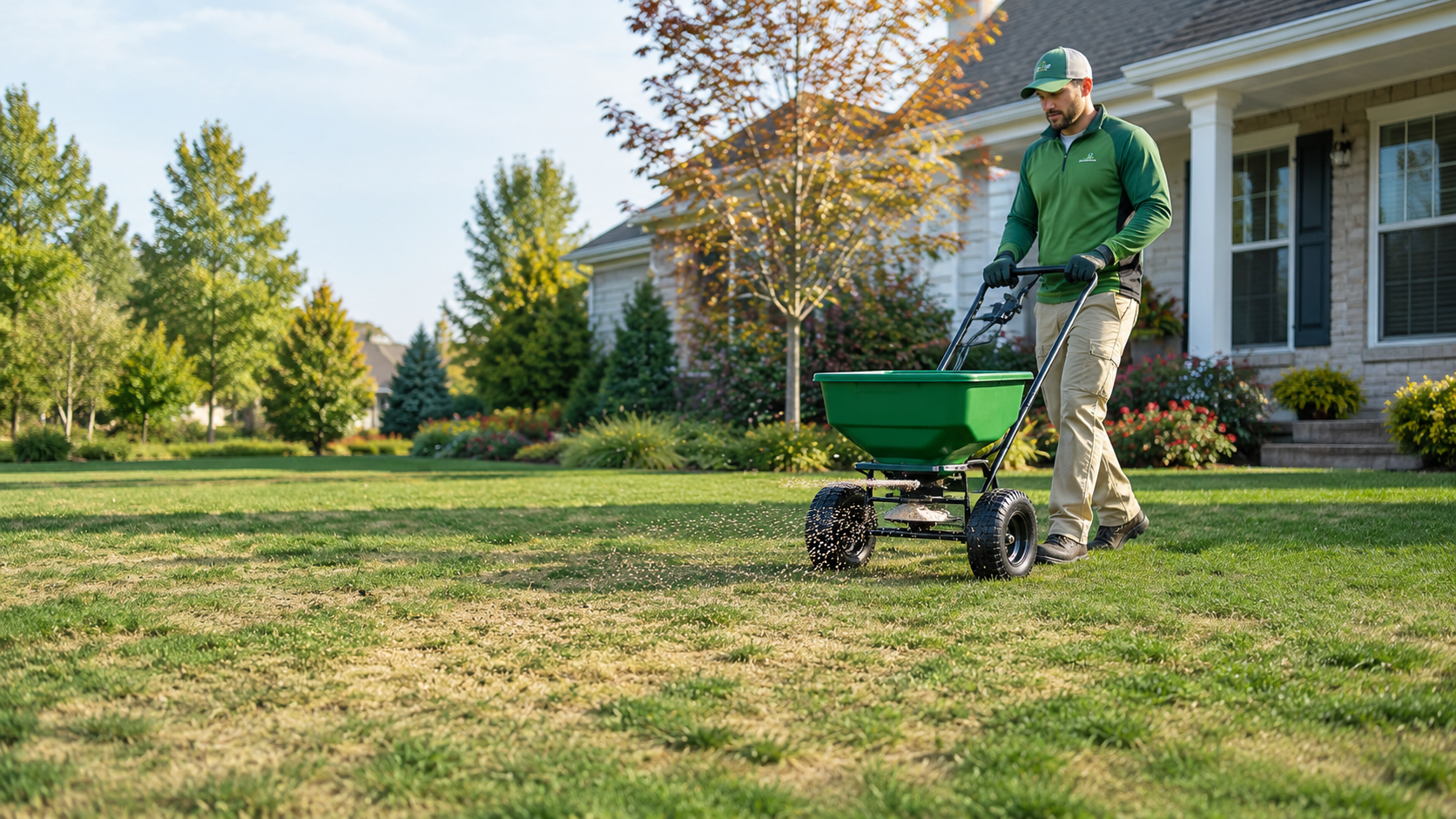
- Equipment: A broadcast spreader works best for large areas. A drop spreader gives you more precise edges. For small patches, hand-broadcasting is fine if you’re careful.
- Technique: Split your seed into two equal portions. Spread the first half in one direction, north to south. Spread the second half perpendicular to that, east to west. This ensures even coverage and avoids skips.
- Overseeding tip: Mow the existing lawn as short as possible, 1.5–2 inches, and bag the clippings. Then run a slice seeder or verticutter over it to cut grooves into the soil. This is what dramatically improves seed-to-soil contact. No slice seeder? Core aerate heavily, then broadcast seed. This ties directly into why core aeration and liquid aeration matter so much for seed-to-soil contact, since the holes catch and hold the seed right where it needs to be.
Step 3: Ensure Seed-to-Soil Contact
After spreading, lightly rake the area to mix seed into the top ⅛–¼ inch of soil. Don’t bury it deeper than ¼ inch. Most grass seed needs light to germinate.
For bare soil, roll the area with a lawn roller filled halfway with water to press seed into the ground. For overseeding, the aeration holes or slice seeder grooves do this job for you. Dragging a piece of chain-link fence or an old doormat over the area works too.
If you’re top-dressing with compost, spread it after seeding, not before. A ¼-inch layer over the seed acts as a mulch, holding in moisture and hiding seed from birds.
Step 4: Apply Starter Fertilizer
Use a starter fertilizer high in phosphorus, the middle number on the bag, like 18-24-12. This promotes strong root development.
Apply at the rate recommended on the bag, usually 1–1.5 lbs of nitrogen per 1,000 sq ft. Water it in right after application.
Step 5: Water Immediately and Correctly
This is where most DIYers fail. The goal is to keep the top ½ inch of soil consistently moist, not soggy, not dry, until seedlings emerge.
Set up an oscillating sprinkler with a timer. Water 3–4 times a day for short durations, 5–10 minutes each. Hot, windy days may call for more frequent misting.
Once seedlings reach 2 inches tall, gradually cut back on frequency and water deeper instead.
Post-Seeding Care: Watering, Mowing, and Fertilizing

Week-by-Week Watering Schedule
- Weeks 1–2 (germination): Water 3–4 times daily, just enough to keep the surface dark and moist. Avoid puddling. Seed washing away? Cut back on pressure or duration.
- Weeks 3–4 (seedling establishment): Drop to once daily, but water deeper, about ½ inch. This pushes roots to chase moisture downward instead of staying shallow.
- Week 5 and beyond: Shift to a normal deep-and-infrequent schedule: 1–1.5 inches per week, split into 2–3 sessions. Water early in the morning to cut down on disease risk.
Can’t water multiple times a day? A seed germination blanket or straw mulch helps retain moisture in the meantime. Just remove it once seedlings hit 1 inch tall.
The First Mow: Timing and Technique
- When: Mow once new grass reaches 3.5–4 inches tall. For tall fescue, that’s usually 3–4 weeks after seeding.
- How: Set your mower to its highest setting, 3.5 inches for fescue. Make sure the blade is sharp. A dull blade tears seedlings right out of the ground instead of cutting them. Bag the clippings for the first few mows so you don’t smother young grass.
Never remove more than one-third of the grass blade in a single mow. That rule matters even more with young seedlings.
Fertilizing After Establishment
About 6–8 weeks after germination, apply a balanced turf fertilizer, something like 16-4-8, at 1 lb of nitrogen per 1,000 sq ft. This keeps root and shoot growth moving.
For tall fescue, a second application in November, a winterizer with higher potassium, helps the grass handle cold better. NC State Extension’s turfgrass fertilization guidance breaks down region-specific nitrogen rates if you want to dial this in further.
Always follow what your soil test recommends over generic bag instructions. Getting this timing and rate right consistently, season after season, is exactly the kind of upkeep a fertilization program is built to handle if you’d rather not track it yourself.
Weed and Pest Management During Establishment
The Pre-Emergent Trap: Why You Must Avoid It
Pre-emergent herbicides, the kind found in most crabgrass preventers, work by stopping seed germination. That includes your new grass seed.
Never apply a pre-emergent within 8–12 weeks before or after seeding. Seeded in fall? Wait until spring, and only after the new grass has been mowed at least 2–3 times.
Winter annual weeds like henbit and chickweed showing up in your new fall seeding? Hand-pull them, or spot-treat with a post-emergent herbicide labeled safe for young turf. Always check the label for seedling safety first.
Common Pests in New NC Lawns
- Grubs (white grubs). These feed on grass roots, causing wilting and dead patches. Seeing more than 5–10 grubs per square foot? Treat with a curative insecticide in late summer. Preventative products like imidacloprid go down in May–June.
- Armyworms and sod webworms. These chew on grass blades, leaving notched edges behind. Treat with B.t. (Bacillus thuringiensis) or spinosad if you want an organic option.
- Fungus (brown patch, damping off). Overwatering and high humidity can trigger fungal disease in young seedlings. Water early in the day, improve air circulation, and skip nitrogen-heavy fertilizer during hot, humid stretches.
If grub damage becomes a recurring problem in your new lawn, grub control is one of the more straightforward fixes to hand off, since timing the preventative treatment right is what makes or breaks it.
For anything you can’t confidently diagnose yourself, NC State’s Turfgrass Pest Management guide is a solid reference, and the NC State Plant Disease and Insect Clinic accepts samples if you want a lab-accurate answer instead of a guess.
Common Seeding Mistakes and How to Avoid Them
Mistake 1: Planting Too Deep
Grass seed buried more than ¼ inch deep runs out of energy before it ever reaches the surface.
Solution: After spreading, lightly rake or roll. Never till seed in.
Mistake 2: Using the Wrong Grass for the Site
Planting Bermuda in shade, or tall fescue in full sun with no irrigation, is a recipe for failure.
Solution: Use the decision framework earlier in this guide to match your grass to your yard’s actual conditions.
Mistake 3: Skipping the Soil Test
Without knowing your pH and nutrient levels, you’re flying blind.
Solution: Test every 2–3 years, and always before a major seeding project.
Mistake 4: Over- or Under-Watering
Too much water causes seed to rot or wash away. Too little causes it to dry out and die.
Solution: Follow the week-by-week watering schedule and use a timer so you’re not guessing.
Mistake 5: Mowing Too Soon or Too Short
Cutting new grass before it’s established can uproot seedlings before they’ve had a chance to root in.
Solution: Wait until grass is at least 3.5 inches tall, and set the mower high.
Mistake 6: Applying Pre-Emergent Herbicides at the Wrong Time
This is a surefire way to kill your new seed before it even has a chance.
Solution: Mark your calendar. Avoid pre-emergents for at least 8 weeks before and after seeding.
If you’ve already made one of these mistakes, don’t panic. Most lawns can be repaired with a follow-up overseeding in the next appropriate window. Learn from it and adjust.
Frequently Asked Questions
Can I just throw seed over my existing lawn?
You can, but you’ll get poor results. Seed needs soil contact to germinate. At a minimum, mow low and rake vigorously to expose soil before seeding. For best results, core aerate or use a slice seeder first.
How long until I can walk on the new lawn?
Avoid foot traffic until the first mow, about 3–4 weeks in. After that, light use is fine, but keep kids and pets off for another month so the roots have time to strengthen.
Should I cover new seed with straw?
Straw helps retain moisture and hide seed from birds. Use it sparingly, one bale per 1,000 sq ft. Avoid hay, since it carries weed seeds. Remove any excess straw once the grass reaches 1 inch tall.
Can I seed in the spring if I missed fall?
It’s risky, but possible. Seed very early, March to early April, and be ready to water all summer. Expect some loss, and plan to overseed again in fall.
How do I fix a lawn that's half Bermuda and half fescue?
You’ve got two options. Embrace the Bermuda and stop overseeding fescue, or kill the Bermuda with a non-selective herbicide in summer and start fresh with fescue in fall. Mixing the two rarely looks good long-term.
When can I apply weed killer after seeding?
Wait until the new grass has been mowed at least 2–3 times. Then use a post-emergent herbicide labeled for your grass type. Read the label closely, since some products can damage young turf.
These answers align with NC State Extension guidance. Your county extension office can offer a deeper dive if your situation doesn’t quite fit the standard playbook.
Final Thoughts: Your NC Lawn Seeding Action Plan
You now have everything you need to transform your North Carolina lawn.
The key takeaways are simple:
- Test your soil first
- Choose the right grass for your region and light
- Seed at the right time, fall for fescue, late spring for warm-season grasses
- Water like a pro, not by guesswork
Print the regional calendar, tape it to your garage wall, and follow it month by month. When in doubt, call your county extension office. They’re your best local resource for anything specific to your yard.
And if you’d rather skip the trial and error altogether, Advanced Turf Care handles seeding, aeration, and the ongoing care that keeps a North Carolina lawn thick and healthy year-round. Reach out anytime you want a second opinion or a hand getting it done right.
Want Better Fescue Density This Fall?
Give new seed the best possible start with a properly timed overseeding plan.
Explore Overseeding