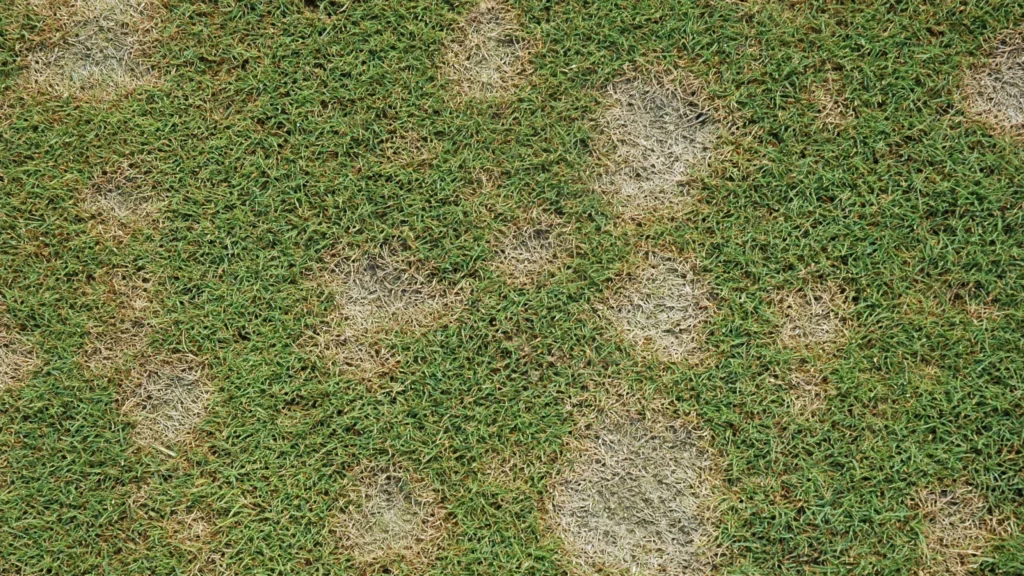
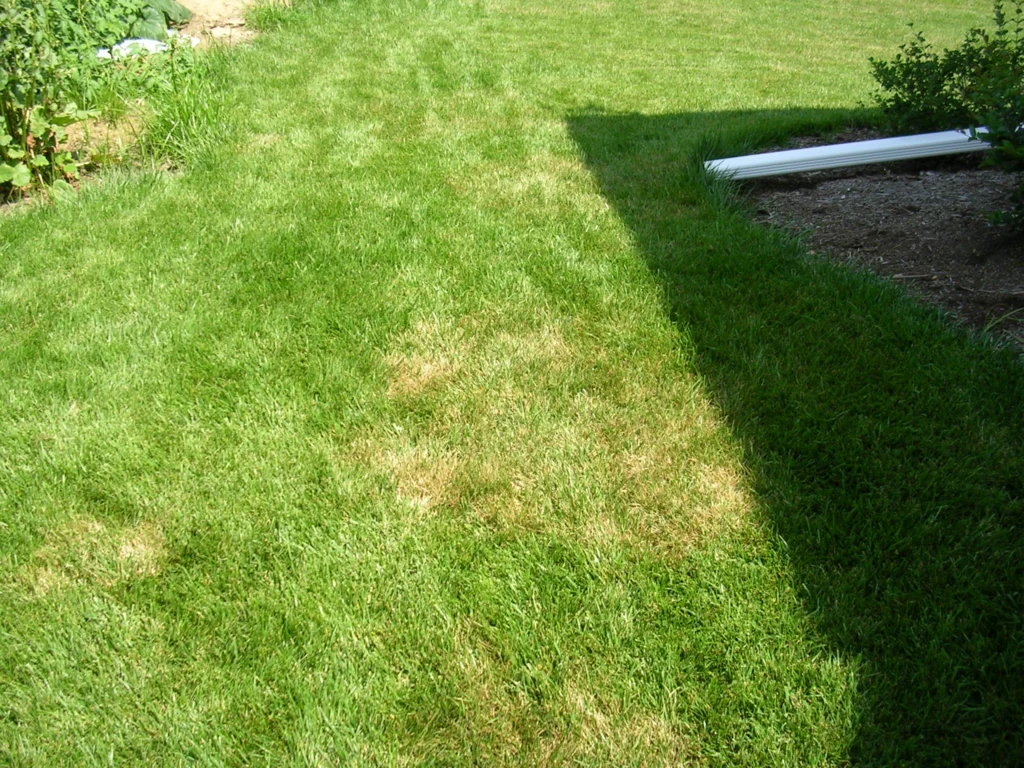
You walk outside one morning and notice pink or reddish patches scattered across your lawn. The grass looked fine a few days ago, but now parts of it appear dry, faded, and covered in strange red threads.
If this sounds familiar, your lawn may have red thread disease.
Red thread is a fungal disease that affects several types of grass, including fescue lawns in Charlotte, NC. It often appears during cool, wet weather and can make a healthy lawn look damaged in a short time.
The good news? Red thread usually doesn’t kill the grass. With proper care, many lawns recover without the need for fungicides.
The first step is knowing what you’re dealing with. Once you can spot the signs and understand what caused the problem, treating red thread becomes much easier.
1. What Is Red Thread Lawn Disease?
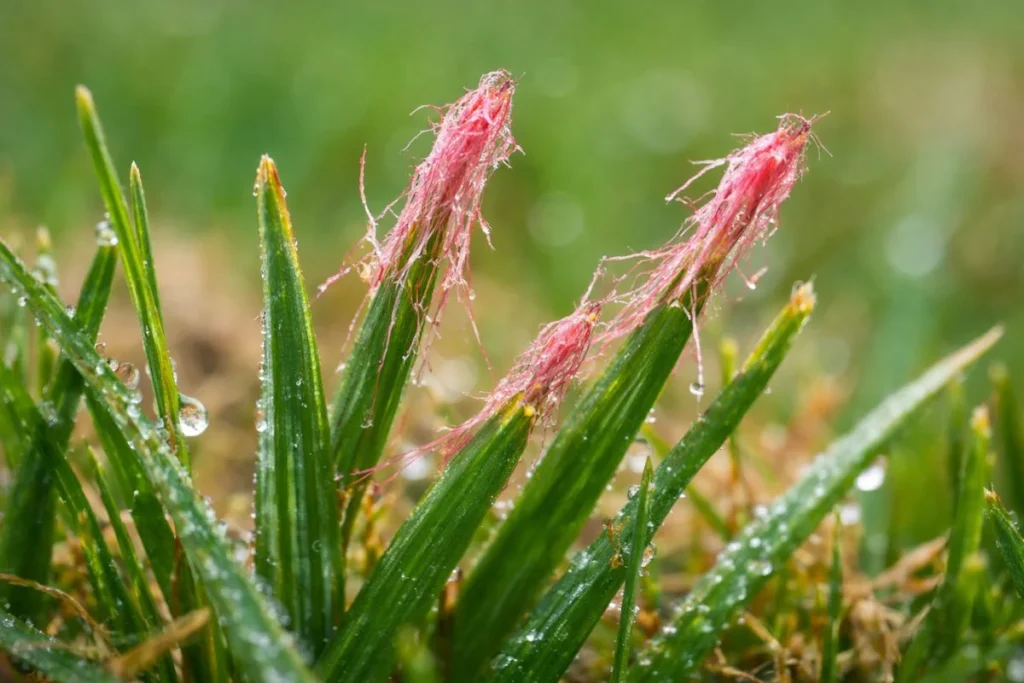
Red thread is a fungal lawn disease caused by Laetisaria fuciformis. It attacks grass blades, turning them tan, pale brown, or almost white. As the disease develops, thin pink or red strands grow from the affected leaves.
These strands give the disease its name.
The fungus mainly damages the leaves rather than the roots or the crown, which is the growing part near the soil. This means the grass can often grow new, healthy blades once conditions improve.
Red thread is most common in cool-season grasses, including:
- Tall fescue
- Fine fescue
- Perennial ryegrass
- Kentucky bluegrass
Charlotte sits in North Carolina’s transition zone, where both warm-season and cool-season grasses grow. Tall fescue lawns can face disease pressure when mild temperatures, damp weather, and slow grass growth come together.
Why does red thread appear so suddenly?
The fungus can survive on infected grass material between outbreaks. When the weather becomes favorable, it starts growing again.
You might not notice anything wrong at first. Then, after several damp days, small patches begin to change color. The pink strands become easier to see, and nearby patches may join together.
The damage often looks worse than it really is.
However, a lawn that keeps developing red thread may have another problem, such as poor nutrition, too much moisture, or slow growth. Finding that underlying issue is important if you want to keep the disease from returning.
2. How to Identify Red Thread in Your Lawn
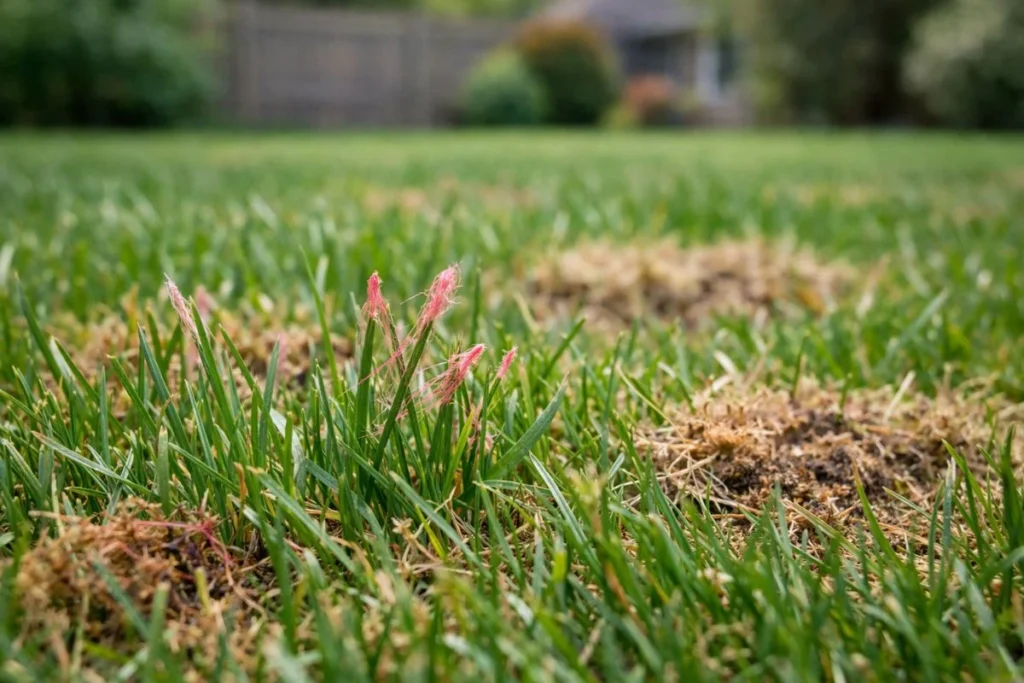
A lawn with red thread may look dry or unhealthy from a distance. But once you get close to the grass, the signs become much clearer.
Look for pink or red threads
The easiest way to recognize red thread is to examine individual grass blades.
You may notice:
- Pink or reddish strands: Thin, thread-like growth extending from the tips of affected leaves.
- Tan or bleached grass: Blades lose their green color as the fungus damages them.
- Small, irregular patches: Affected areas often measure about 4 inches to 2 feet across.
- Pink, fuzzy growth: Fine cotton-like material may appear when the grass is wet.
- Patches joining together: Several small areas can merge into larger sections of faded grass.
The red strands are fungal structures called sclerotia. They help the fungus survive and spread.
According to NC State Extension’s red thread guide, the disease can produce both red strands and pink, fuzzy growth on affected leaves.
Check your lawn in the morning
Early morning is a good time to inspect suspected red thread.
Dew and high humidity make the pink fungal growth easier to see. Look closely at the tips and sides of the affected grass blades.
You may see thin strands that look like bits of red sewing thread.
Avoid judging the problem only by the color of the lawn. Brown or tan patches can have several causes, including other diseases, heat stress, and poor watering.
Is it red thread? A quick symptom check
Ask yourself these questions:
- Are there small tan or reddish patches in the lawn?
- Can you see pink or red strands attached to individual grass blades?
- Has the weather been cool, cloudy, or rainy recently?
- Does the affected grass seem to be growing slowly?
- Is the damage mostly on the grass blades rather than the roots?
If several answers are yes, red thread is a strong possibility, especially if the red strands are present.
This check is a useful starting point, not a final diagnosis. If the signs are unclear, a lawn care professional or plant diagnostic lab can help identify the problem.
Red thread vs. other lawn diseases
Not every discolored patch is red thread. Here is how some common lawn problems differ.
| Lawn problem | Common appearance | Main difference |
|---|---|---|
| Red thread | Tan patches with pink or red strands | Red threads grow from affected blades |
| Pink patch | Faded grass with pink, cotton-like growth | Lacks the firm red strands typical of red thread |
| Rust | Yellowing grass with orange powder | Orange spores can rub onto shoes or hands |
| Dollar spot | Small, pale patches with tan leaf lesions | Often has light leaf spots with darker edges |
| Brown patch | Larger brown or tan areas | More common during hot, humid weather on fescue |
Rust is particularly easy to confuse with other lawn problems from a distance. If you notice orange dust rather than pink threads, our guide on how to identify and treat rust in lawns explains what to look for.
A close inspection can save you from treating the wrong disease.
3. What Causes Red Thread?
Red thread develops when the fungus, a susceptible grass, and favorable weather come together.
But weather is not the only factor.
A lawn that is growing slowly or struggling with poor conditions is often more likely to show damage.
Cool, wet weather
Red thread grows well during mild, damp conditions.
The fungus can develop across a wide temperature range, but NC State reports that it grows fastest around 70°F.
Long periods of rain, cloudy skies, and moisture on the grass can encourage an outbreak.
This is why homeowners may notice the disease during spring or fall. Warm days followed by cool, damp nights can leave grass wet for hours.
Low nitrogen and poor nutrition
Grass needs nitrogen to produce healthy green growth.
When a lawn receives too little nitrogen, it may grow slowly and struggle to replace damaged leaves. Red thread often becomes more noticeable under these conditions.
However, red thread does not always mean your lawn needs more fertilizer.
Grass may also grow slowly because of shade, drought, compacted soil, or unsuitable temperatures.
Adding too much nitrogen can create new problems, including greater risk of certain other lawn diseases. The goal is proper nutrition, not rapid growth at any cost.
Compacted soil
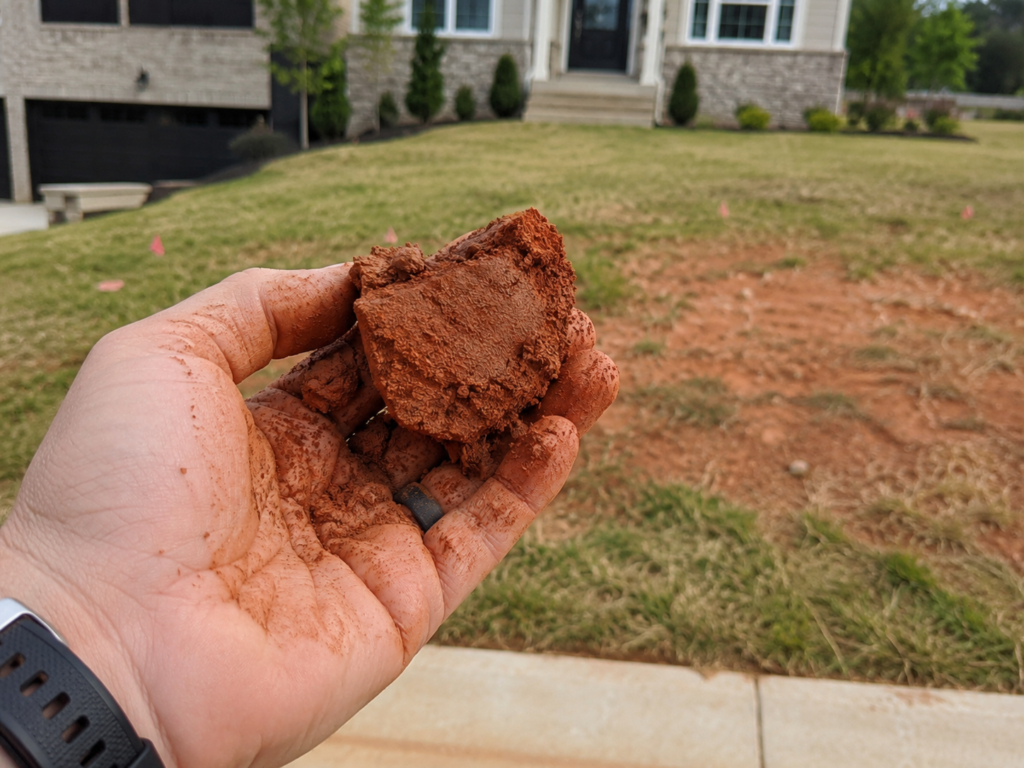
Many Charlotte-area lawns have clay-heavy soil.
Clay can support healthy grass, but regular foot traffic and heavy equipment can squeeze the soil particles together.
When soil becomes compacted, water has a harder time soaking in, and roots have less room to grow.
Grass with weak roots may struggle during dry weather or periods of disease pressure.
Excessive thatch
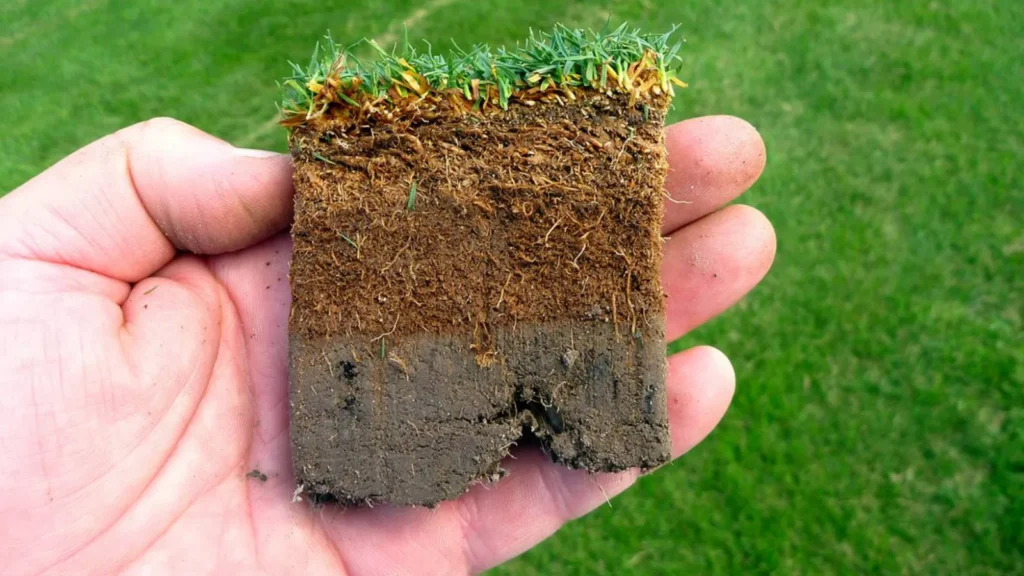
Thatch is a layer of dead stems, roots, and other plant material between the green grass and the soil.
A thin layer is normal and can be helpful. A thick layer, however, may hold moisture near the grass and interfere with the movement of water and air.
Not every fescue lawn has a thatch problem. Removing thatch when it is not needed can damage healthy turf.
Poor airflow and too much shade
Think about the areas near a fence, under dense branches, or between closely planted shrubs.
These spots often stay damp longer than open parts of the lawn.
Less sunlight and weak airflow can slow grass growth and keep leaves wet, creating favorable conditions for red thread.
Mowing and watering mistakes
Cutting grass too short puts extra stress on the plant. Dull mower blades can also tear leaves instead of making clean cuts.
Watering creates another common problem.
If sprinklers run frequently or late in the evening, grass may stay wet for long periods.
That extra moisture gives the fungus more time to grow.
The solution is not to stop watering or mowing. It is to adjust both practices to match the needs of your grass.
4. How to Prevent Red Thread
Preventing red thread starts with maintaining grass that can grow well through changing weather.
You cannot control every rainy week in Charlotte, but you can improve the conditions in your own yard.
Follow a proper fertilization plan
A healthy lawn needs the right nutrients at the right time.
For tall fescue in North Carolina, fall is an important fertilization period. Spring applications should be more careful, and heavy nitrogen feeding during summer heat can cause problems.
A slow-release nitrogen fertilizer can provide steady nutrition without pushing too much growth at once.
Before making major changes, consider a soil test.
Soil tests help identify pH problems and levels of nutrients such as phosphorus and potassium. Standard North Carolina soil tests do not directly measure nitrogen, but they provide fertilizer recommendations for your grass type.
Water deeply, but not too often
Grass needs water to grow. The goal is to provide enough moisture without leaving the blades wet longer than necessary.
For established fescue lawns:
- Water early in the morning.
- Allow the soil surface to dry between watering sessions.
- Avoid evening irrigation.
- Adjust sprinkler schedules after rainfall.
- Check the soil instead of watering only by the calendar.
NC State recommends watering during the early morning hours to limit the time grass remains wet.
On clay soil, water may soak in slowly. If you see runoff, stop and allow the water to enter the soil before continuing.
A watering timer or smart irrigation controller can help prevent unnecessary watering, especially during rainy weeks.
Mow at the right height
Taller fescue grass can shade the soil and support stronger growth during stressful weather.
NC State generally recommends mowing established tall fescue between 2.5 and 3.5 inches, depending on the season. During summer, the higher end of that range is often better.
Bermuda and Zoysia need different cutting heights, so do not use one setting for every lawn.
Keep mower blades sharp and avoid removing more than one-third of the grass blade during a single mowing.
If red thread is active, collect clippings from the affected area when practical. Clean infected grass material from the mower before moving to healthy areas.
Once the disease is under control, leaving normal clippings on the lawn helps return nutrients to the soil.
Improve soil health with core aeration
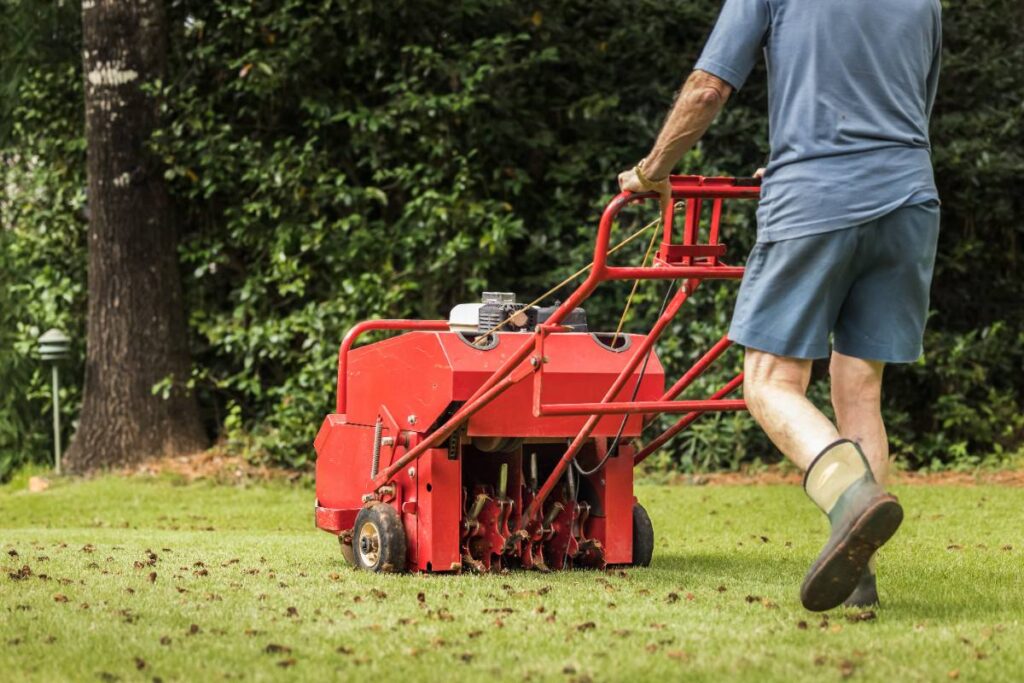
If your lawn has hard soil, poor drainage, or heavy foot traffic, core aeration may help.
A core aerator pulls small plugs of soil from the ground. These openings reduce compaction and help water, air, and nutrients reach the roots.
This supports stronger grass over time.
You can learn more about why core aeration helps compacted lawns and how it differs from liquid aeration.
Spike shoes are not a direct replacement for proper core aeration on heavily compacted soil.
Dethatching is another option when a lawn has a thick thatch layer, but it should only be done when necessary.
Neither aeration nor dethatching is an instant cure for red thread. Their value comes from improving the growing conditions that help grass stay healthy.
Improve sunlight and airflow
Look for areas that stay wet long after the rest of your lawn has dried.
Trimming crowded vegetation where appropriate can allow more light and air to reach the grass.
Avoid planting shrubs so tightly that they block airflow around lawn edges.
If an area receives very little sunlight, consider whether the grass growing there is suited to the conditions.
Seasonal red thread prevention calendar for Charlotte
| Season | What to focus on |
|---|---|
| Spring | Watch for pink patches after wet weather. Check lawn growth and avoid excess nitrogen. |
| Summer | Water early, maintain the right mowing height, and protect fescue from heat stress. |
| Fall | Inspect for returning disease, correct soil problems, and plan fescue aeration or overseeding where needed. |
| Winter | Remove heavy leaf cover, avoid unnecessary watering, and plan maintenance for the coming growing season. |
These are general guidelines for established Charlotte-area lawns. Your grass type, soil, and weather should determine the final schedule.
5. How to Treat Red Thread Step by Step
If red thread is already visible, you do not need to reach for a fungicide immediately.
Start by checking the damage and correcting conditions that may be helping the disease spread.
Step 1: Confirm the problem and assess the damage
Inspect several affected grass blades.
Look for the red strands and pink fungal growth described earlier. Check whether the patches are small and scattered or spreading across a larger part of the yard.
If you cannot find the red threads, investigate other causes before applying treatment.
For example, dollar spot also creates pale patches but has different signs on individual leaves. Our article on what dollar spot looks like and how to manage it can help you compare the symptoms.
If the lawn is thinning badly or the diagnosis remains uncertain, seek professional help.
Step 2: Correct the growing conditions
Once you have identified red thread, focus on helping the grass produce healthy new growth.
Start with these actions:
- Check fertilization: If the lawn is underfed, use an appropriate fertilizer based on its grass type and growing season.
- Correct watering: Avoid frequent, light watering that leaves grass damp for long periods.
- Adjust mowing: Maintain the recommended cutting height and keep blades sharp.
- Improve airflow: Help shaded or sheltered areas dry more quickly.
- Manage infected clippings: Collect clippings from active patches and clean grass debris from equipment.
Do not apply a strong nitrogen dose simply because you notice red thread.
For fescue lawns, excess fertilizer during hot weather may create more problems than it solves.
Step 3: Consider nonchemical care first
Many mild red thread outbreaks improve with basic lawn care.
This is often the best starting point for homeowners who want to avoid unnecessary chemical treatments.
Some gardening guides suggest neem oil or compost tea as natural fungal treatments.
However, there is not enough reliable evidence to recommend either one as a dependable cure for red thread.
Compost and other organic materials may support soil health when used properly, but improving soil conditions is different from directly controlling an active fungus.
If you choose an organic product, check that it is intended and labeled for the proposed use. Do not assume something is safe simply because it is called natural.
Step 4: Use a fungicide only when necessary
Fungicides may be worth considering when red thread is severe, continues spreading, or repeatedly damages a high-value lawn.
Products containing active ingredients such as azoxystrobin or propiconazole may be effective against red thread when their labels specifically permit that use.
These are not interchangeable with every lawn fungicide. Product formulation, grass type, application timing, and labeling all matter.
Some fungicides move into plant tissue, while others mainly protect treated surfaces.
Treatments generally work better before heavy disease damage occurs or when symptoms first appear. They cannot turn already damaged leaves green again.
If a fungicide is needed:
- Choose a product labeled for red thread and your lawn type.
- Follow the exact application rate and timing on the label.
- Use the required protective equipment.
- Keep children and pets away for the period stated on the label.
- Avoid applying products before rain if the label warns against it.
- Do not repeat applications more often than permitted.
Repeated use of the same fungicide group can also increase the risk of resistance.
For most home lawns, NC State Extension advises that proper lawn care usually makes fungicide use unnecessary.
Step 5: Monitor the lawn after treatment
Take a photograph of the affected area before making changes.
Check it again over the following days and weeks.
Look for new green leaves, fewer active red strands, and patches that are no longer expanding.
If you applied a fungicide, follow its label for any post-application watering instructions. Some products require watering in, while others do not.
Remember that even successful treatment will not instantly repair damaged grass. Recovery depends on the grass growing new leaves under better conditions.
6. Fungicides vs. Organic Treatments
There is no single best treatment for every red thread outbreak.
A small patch on an otherwise healthy lawn is different from repeated disease across a large area.
The first choice should usually be between improving lawn care alone and adding a product when there is a sound reason to do so.
Fungicide treatments
Fungicides can reduce fungal activity when correctly chosen and applied.
Their main benefits are more direct disease control and the ability to protect vulnerable grass during periods of high disease pressure.
However, they also have limits.
They cost money, require careful handling, and may need repeat applications. Incorrect use can harm the environment or expose people and pets to unnecessary risk.
A fungicide also does not solve poor drainage, weak grass growth, or other underlying lawn problems.
Organic and nonchemical approaches
Nonchemical care focuses on improving the conditions that allow grass to recover.
That includes proper nutrition, irrigation, mowing, and soil management.
These practices often cost less in product purchases and can support long-term lawn health.
However, they require consistency. They do not always stop a serious outbreak quickly, and products marketed as organic fungal remedies may lack strong evidence for red thread control.
Which option makes more sense?
| Factor | Fungicides | Nonchemical lawn care |
|---|---|---|
| Main purpose | Direct disease control | Improve grass health and growing conditions |
| Typical cost | Product and application costs | Varies with lawn condition and maintenance needs |
| Time and effort | Careful application and monitoring | Ongoing lawn maintenance |
| Effectiveness | Can control red thread when properly used | Often enough for mild to moderate outbreaks |
| Environmental concerns | Depends on product and application | Usually avoids fungicide exposure |
| Long-term value | Does not fix underlying causes | Helps address recurring lawn stress |
The best approach often follows integrated pest management, or IPM.
This means identifying the disease first, checking how serious it is, improving lawn conditions, and using a targeted product only when needed.
It helps avoid unnecessary treatments while still allowing effective control when the situation calls for it.
7. How to Help Your Lawn Recover
Once the active disease begins to settle down, your next job is supporting new grass growth.
Red thread mainly damages the leaves. If the growing points remain healthy, the lawn can often recover as new blades replace the affected ones.
You may see improvement within a few weeks when growing conditions are favorable. Cooler temperatures, drought, or other stress can slow that process.
Watch for healthy new growth
Do not expect every brown blade to become green again.
Instead, look for fresh leaves emerging among the damaged grass.
You should gradually notice that the faded patches look smaller and the lawn becomes more even in color.
If areas remain thin after the disease is gone, they may need additional care.
Repair compacted areas at the right time
On Charlotte’s clay-heavy soil, fall is generally a good time to aerate established fescue lawns that need it.
Aeration can also be paired with overseeding to help fill thin areas.
Timing matters. Working on fescue during summer stress may cause more harm than good.
Our guide on when to aerate lawns in North Carolina explains how the best season changes with grass type and local conditions.
For Bermuda and Zoysia, aeration is generally better during active warm-season growth.
Build better soil over time
Healthy soil supports healthy roots.
Organic matter can help improve soil conditions, while beneficial soil organisms play a role in breaking down plant material and cycling nutrients.
Compost may be useful in some lawn care plans, but applying it does not guarantee that red thread will disappear.
Focus on the basics: suitable soil conditions, proper nutrients, strong roots, and healthy grass growth.
These give your lawn a better chance of handling disease pressure in the future.
Keep watching problem areas
Some lawns develop red thread in the same spots year after year.
If that happens, pay attention to what makes those areas different.
Perhaps they receive less sunlight, stay wet longer, or have heavily compacted soil.
Finding and correcting that issue can be more useful than repeatedly treating the visible patches.
8. Frequently Asked Questions About Red Thread
The greater concern is any lawn treatment product you choose to apply. If a fungicide is used, follow its label instructions for keeping pets and children away from the treated area. Never assume a treated lawn is safe to enter before the required period has passed.
Is red thread harmful to pets?
Red thread is a fungal disease of grass, not a disease known to infect dogs or cats.
However, severe outbreaks can cause noticeable thinning, especially if the lawn is already stressed. Most affected grass can recover when growing conditions improve. Very weak or badly damaged areas may need repair.
Can red thread kill my lawn?
Red thread usually does not kill established grass because it primarily affects the leaves rather than the roots and crown.
The exact time depends on how badly the leaves were damaged, how fast the grass is growing, and whether other problems are present. If the grass is growing slowly, visible recovery may take longer.
How long does it take to get rid of red thread?
Many lawns begin recovering within a few weeks when the weather improves and the grass receives proper care.
In Charlotte, these conditions can occur when mild temperatures and frequent rain keep grass wet for long periods. The disease can also develop outside those seasons when conditions are favorable.
What time of year is red thread most common?
Red thread is most common during cool, wet periods in spring and fall.
Many lawns recover without fungicides. However, the fungus can survive between outbreaks. If the same poor growing conditions return, another outbreak is possible. That is why good lawn maintenance matters even after the visible symptoms disappear.
Will red thread go away on its own?
Yes, red thread can become less active when the weather changes and the grass begins growing well again.
Common myths about red thread
Myth: Mowing height doesn’t matter.
Fact: Cutting grass too short can weaken it and make recovery harder. Proper mowing supports healthy growth.
Myth: Only chemical treatments can control red thread.
Fact: Many outbreaks improve with proper fertilization, watering, and other lawn care changes. Fungicides are not always needed.
Myth: Red thread will always disappear without any action.
Fact: The disease may become less active on its own, but recurring lawn stress can allow it to return.
Myth: There is no way to prevent red thread.
Fact: You cannot control the weather, but healthy grass, proper nutrition, good airflow, and sensible watering can reduce the risk.
9. Final Thoughts
Red thread can make your lawn look unhealthy, but it is usually a manageable problem.
Start by checking for the pink or red strands that make this disease different from other lawn problems. Then look at the conditions around the affected areas.
Is the grass growing slowly? Does the soil stay wet? Is the lawn receiving the right nutrients?
Often, improving these basic conditions is enough to help the grass recover.
For homeowners in Charlotte, Gastonia, Huntersville, Belmont, and nearby communities, local weather and soil conditions play a big role in keeping lawns healthy.
At Advanced Turf Care, we bring more than 20 years of hands-on Carolina lawn care experience to helping homeowners manage lawn disease, fertilization, and soil health.
If red thread keeps returning or your lawn is struggling to recover, contact Advanced Turf Care. We can help identify the underlying problem and recommend a lawn care plan suited to your grass and local conditions.
Seeing Spots, Patches, or Turf Decline?
Lawn disease can spread quickly. Get help identifying the problem and choosing the right treatment.
Explore Disease Control