You water your lawn, apply fertilizer, and keep up with mowing. But some areas still look thin, the ground feels hard, and water sits on the surface after a heavy rain.
The problem might be under your feet.
Compacted soil makes it harder for grass roots to grow and reach the water and nutrients they need. This is a common problem in Charlotte, NC, where many lawns have heavy clay soil.
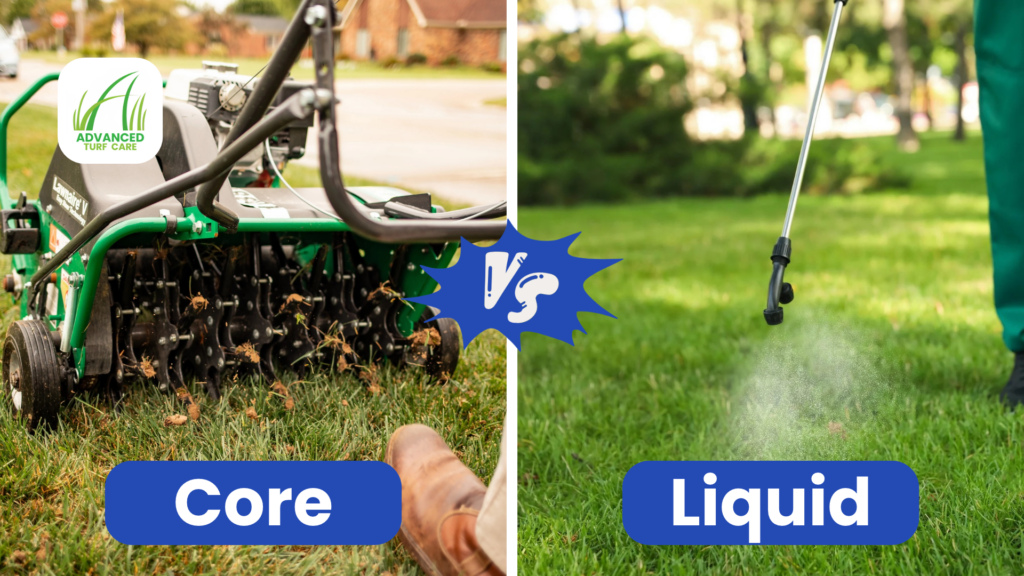
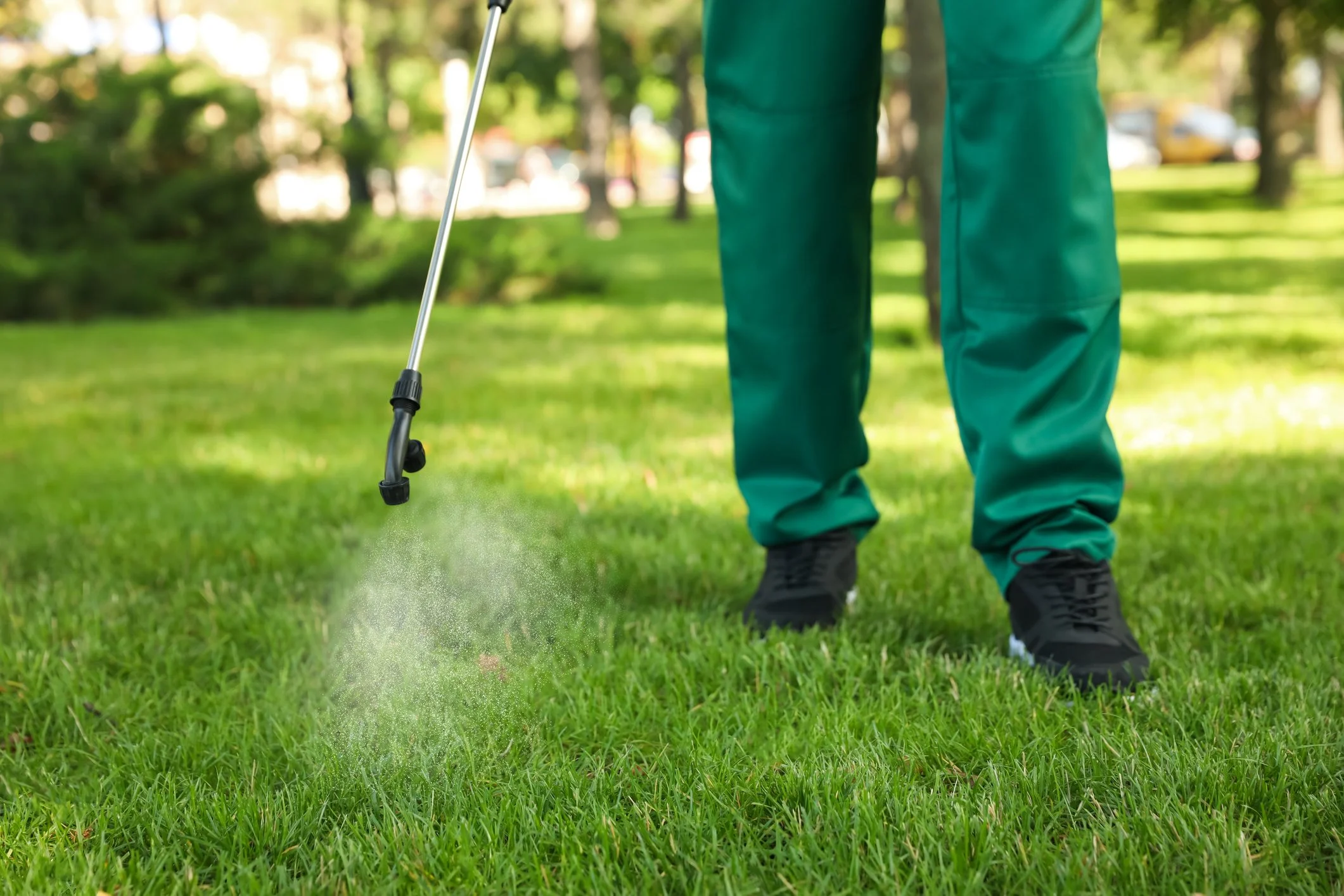
You may have heard that liquid aeration can help. Instead of using a machine to pull plugs of soil out of your yard, you spray a liquid treatment over the grass. It sounds easier, especially if you don’t want to rent heavy equipment.
But does liquid lawn aeration actually loosen compacted soil?
Liquid aeration may help with certain soil and water problems, but it doesn’t replace traditional core aeration. The results depend on the ingredients, your soil, and what’s causing your lawn to struggle.
Here’s what you should know before spending money on a treatment.
Why Does Soil Get Compacted?

Healthy soil has small spaces between its particles. These spaces hold air and water, giving grass roots room to spread.
Soil compaction happens when those spaces get squeezed together.
Think about a sponge. When it’s loose, it can hold water and air. When you squeeze it tightly, there’s less room for either.
Your lawn’s soil can have a similar problem, especially in areas where people walk, children play, or heavy equipment passes over the grass.
Clay soil can be particularly troublesome. It contains very fine particles that can pack tightly together. Many homes around Charlotte, Gastonia, and Belmont have clay-heavy soil, sometimes made worse by construction equipment used when the home was built.
How can you tell if your soil is compacted?
You might notice:
- Water pooling on the grass after rainfall.
- Hard ground that’s difficult to dig.
- Thin grass along walkways or play areas.
- Roots growing close to the surface.
- Bare patches that keep coming back.
An easy check is to push a long screwdriver into moist soil. If it goes in easily in one area but meets strong resistance in another, that harder spot may be compacted.
It’s only a quick check, though. Stones, dry soil, and buried debris can also stop a screwdriver.
Why does your lawn need aeration?
Aeration helps make room for air, water, and roots in the soil.
When soil is packed too tightly, roots have trouble spreading. Even if you water and fertilize, the grass may struggle because its roots can’t reach what they need.
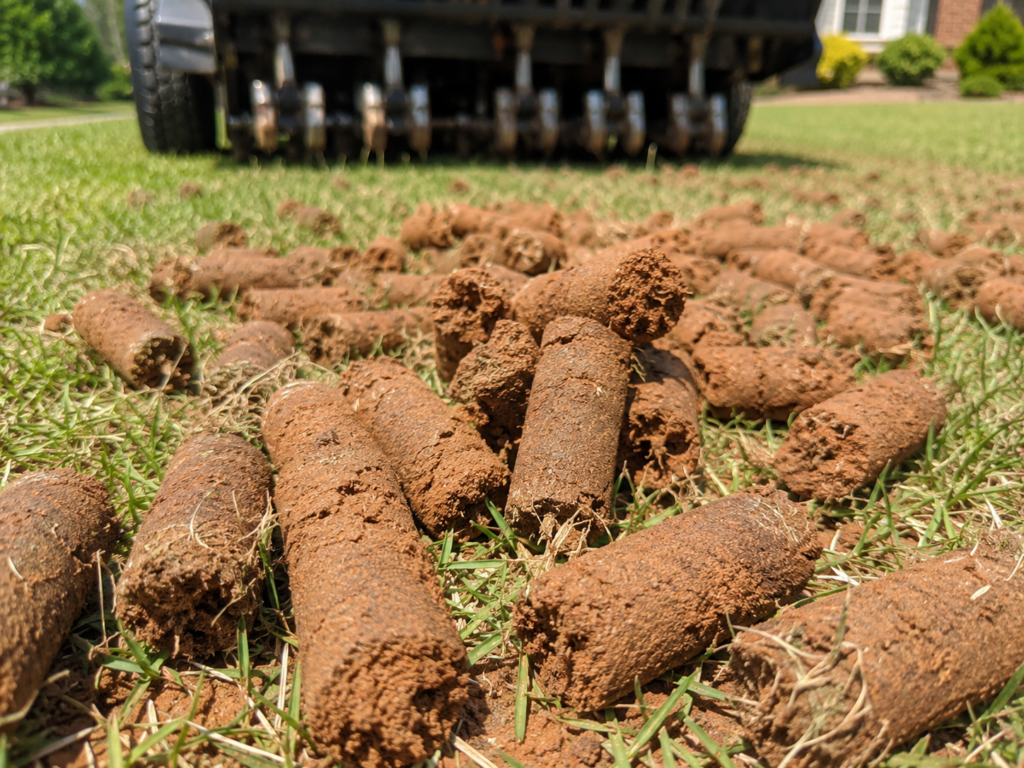
Traditional core aeration addresses this by removing small plugs of soil, leaving open holes behind.
Liquid aeration takes a different approach.
What Is Liquid Lawn Aeration?
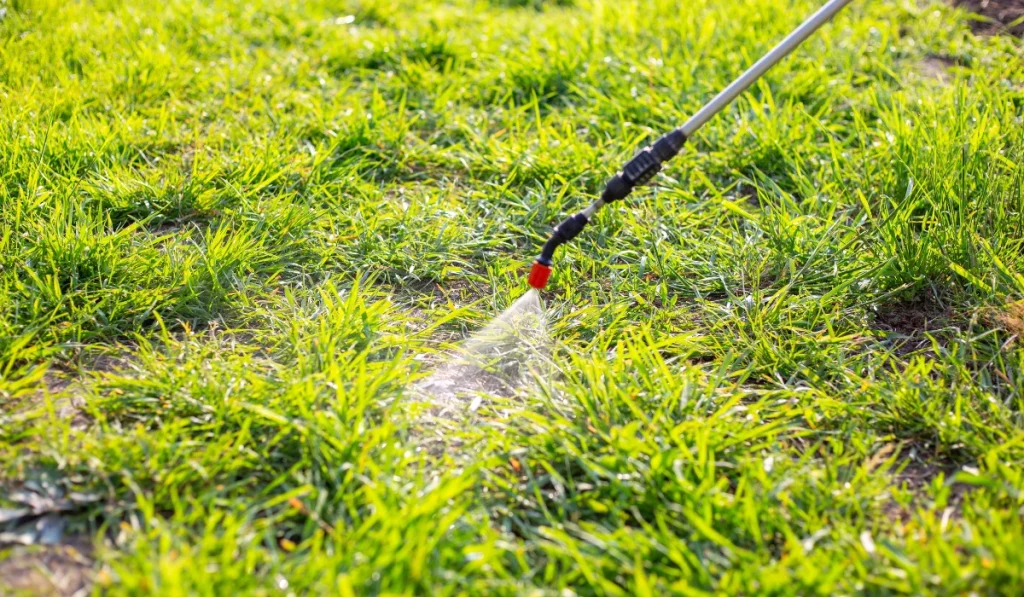
Liquid lawn aeration is a treatment applied to grass and soil using a sprayer. Instead of physically removing soil, it uses ingredients meant to improve soil conditions.
Most products are sold as soil conditioners. They may contain humic acid, wetting agents, seaweed extracts, or other ingredients.
The idea is simple. You spray the treatment onto your lawn, water it in as directed, and allow the ingredients to work in the soil.
But there’s one important difference between what these products claim and what research has shown.
Liquid aeration doesn’t physically remove compacted soil or create the same open spaces as core aeration.
Some ingredients may help water spread through dry soil or support plant growth. That doesn’t mean the treatment has reduced compaction.
For example, a wetting agent might help water soak into a dry patch more evenly. The grass could respond well to that extra moisture, even though the ground remains just as tightly packed.
This is why liquid aeration isn’t necessarily a useless product, but it also isn’t a proven substitute for core aeration.
In September 2026, Iowa State University Extension explained that some liquid treatments had shown benefits for root growth and soil moisture, but had not demonstrated reliable, lasting relief from soil compaction.
Yard and Garden
That distinction matters when deciding whether to use one.
How Does Liquid Aeration Work?
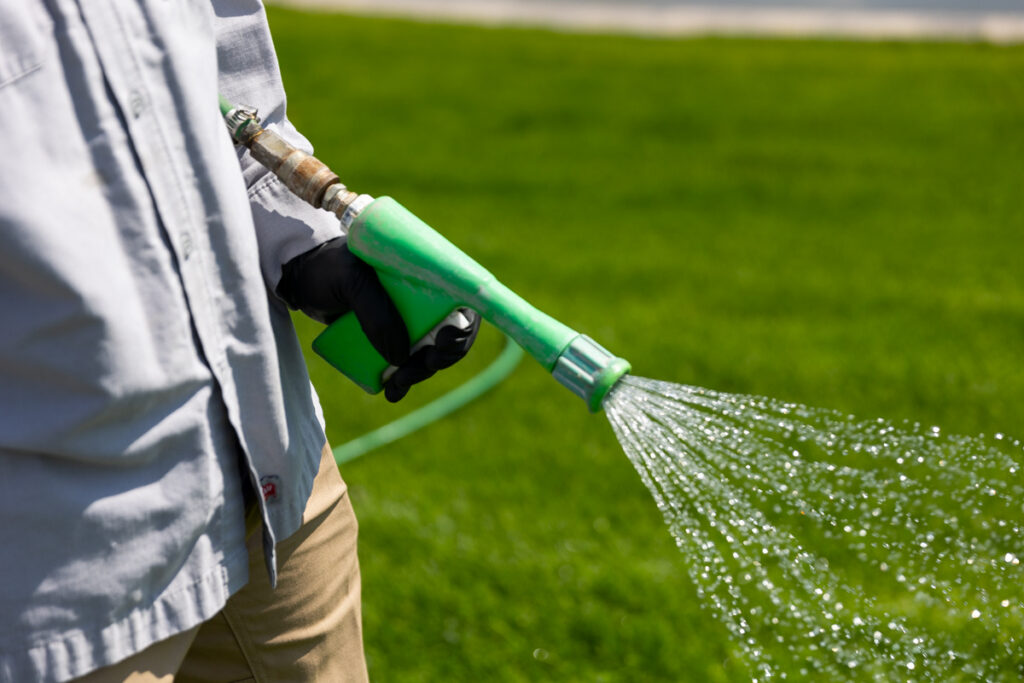
Not every bottle of liquid aerator contains the same ingredients.
Some products focus on helping water enter dry soil. Others contain organic compounds that may affect plant growth or nutrient availability.
To understand what you’re buying, it helps to know what those ingredients actually do.
Humic and fulvic acids
Humic and fulvic acids come from organic material that has broken down over time.
They can interact with nutrients and may help plants make better use of certain nutrients under suitable conditions. They are also used in products designed to support soil health.
You may see claims that humic acid separates tightly packed clay particles or creates open spaces in the ground.
The reality is more complicated.
Soil structure depends on many things, including the clay type, organic matter, moisture, and how much the ground has been pressed down.
Adding a small amount of humic acid does not guarantee that compacted soil will become loose.
Surfactants and wetting agents
Have you ever watered a dry patch of grass and watched the water run across the surface instead of soaking in?
Some soils become water-repellent when they’re very dry.
Wetting agents help water spread over soil particles instead of forming beads. This can make watering more effective in spots where water has trouble soaking in.
The University of Georgia Cooperative Extension explains how wetting agents change the way water moves across surfaces.
UGA Cooperative Extension
But helping water spread is not the same as removing compaction.
A wetting agent may help a dry lawn even when compaction isn’t the main problem.
Kelp and seaweed extracts
Some liquid aeration products contain extracts made from seaweed.
These products may contain compounds that affect plant growth and stress responses. Depending on the formula and growing conditions, they may help support root development.
However, stronger root growth doesn’t prove that the soil itself has become less compacted.
Think of kelp as a possible plant supplement rather than a tool that breaks open hard ground.
Beneficial microbes and enzymes
Your lawn’s soil is home to bacteria, fungi, and other tiny living things.
Many of these organisms help break down dead plant material and release nutrients into forms plants can use.
Some liquid products claim to add helpful microbes or enzymes to improve these natural processes.
One common claim is that they help break down thatch.
Thatch is the layer of dead and living stems and roots that builds up between the green grass and the soil. A little is normal, but too much can cause problems.
You can learn more about what thatch is and when it becomes a lawn problem.
Adding microbes doesn’t guarantee faster thatch breakdown. The results depend on the organisms, soil conditions, and whether they can survive and remain active.
Do these ingredients create more space in the soil?
You may come across terms like flocculation and soil aggregation.
They describe how small soil particles come together into larger groups, which can help create spaces for air and water.
Stable soil aggregates are important for healthy soil. Organic matter, roots, soil organisms, and soil chemistry all play a part.
Some amendments can help these processes under the right conditions.
However, there’s no good reason to assume that spraying any liquid aerator will create new air channels throughout hard clay soil.
For serious compaction, physically removing soil remains the more reliable approach.
What Are the Benefits of Liquid Aeration?
Liquid aeration products can have useful benefits, but those benefits depend on the formula and the problem you’re trying to solve.
Here are the main reasons homeowners consider them.
It’s easier to apply
A liquid treatment usually requires a hose-end sprayer or pump sprayer.
You don’t have to transport a heavy aeration machine, walk it across your entire yard, or clean up soil plugs afterward.
For someone who wants a simple DIY treatment, that’s a major advantage.
It doesn’t leave soil plugs behind
Core aeration leaves small pieces of soil on the grass.
These normally break down over time, but some homeowners dislike how they look.
Liquid applications leave no plugs or machine holes. You also avoid the risk of aerator tines striking sprinkler lines or shallow buried cables.
You still need to keep people and pets off the treated area for as long as the product label requires.
Some products can improve water movement
Wetting agents may help water soak into soil that has become water-repellent.
This can be useful when water runs off a dry area while nearby grass absorbs it normally.
Better wetting may also help moisture reach more of the root zone. Whether that leads to less watering depends on your soil, weather, and irrigation habits.
They may support nutrient use and root growth
Certain humic acid and seaweed products may support plant growth in some conditions.
If your grass responds with healthier roots, it may be better able to use the water and nutrients already in the soil.
However, don’t expect liquid aeration to replace fertilizer or correct a nutrient shortage on its own.
They can fit into a soil care routine
Soil health improves through good watering, healthy roots, proper mowing, and suitable soil management.
A liquid conditioner may have a role within that routine if you’ve identified a problem its ingredients can help with.
For example, a homeowner dealing with water-repellent soil may find a wetting agent useful alongside better watering practices.
The key is choosing a product for a specific reason, not simply because the bottle promises a greener lawn.
What Are the Downsides of Liquid Aeration?
The biggest drawback is that liquid aeration doesn’t have the same evidence behind it as mechanical core aeration.
It may not fix compacted clay soil
Imagine a lawn in Charlotte where construction equipment has pressed the soil down tightly.
The grass struggles because its roots can’t grow through the hard ground.
Spraying a liquid treatment won’t physically remove that packed soil. It may help with moisture or plant growth, but the main compaction problem can remain.
Colorado State University Extension also cautions against treating liquid products as replacements for physical aeration.
PlantTalk Colorado
Results can be hard to measure
With core aeration, you can see the holes and soil plugs immediately.
With liquid treatments, there may be no visible change.
Some products recommend repeated applications before judging results. Even then, greener grass doesn’t automatically mean compaction has improved.
Rainfall, fertilizer, seasonal growth, and better watering could also explain the change.
Multiple treatments increase the cost
A single bottle may seem inexpensive, but regular applications can add up.
If the treatment doesn’t address the real cause of your lawn problem, you could spend money without making much progress.
Not every thin or yellow lawn has a soil problem
Grass can struggle because of shade, poor drainage, insects, disease, or the wrong watering schedule.
For example, grass blades covered with orange dust may have lawn rust disease, not a compaction problem.
Liquid aeration won’t treat that disease.
A lawn that holds standing water for days may also have a grading or drainage issue that no spray can solve.
Before choosing a treatment, make sure you know what you’re trying to fix.
Liquid Aeration vs. Core Aeration: What’s the Difference?
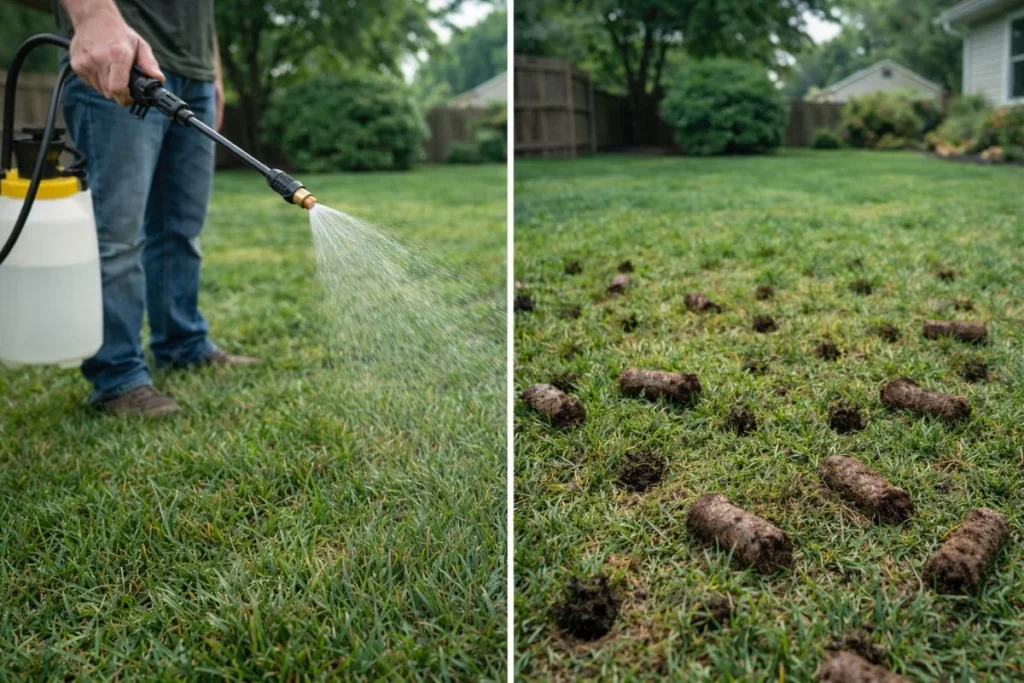
Both treatments are marketed to improve lawn health, but they work in very different ways.
Core aeration uses a machine with hollow tines that pull small plugs from the soil. The openings allow air and water to enter and give roots more room to grow.
Liquid aeration relies on ingredients applied to the lawn. It does not remove soil.
Here’s how they compare.
| Feature | Liquid aeration | Core aeration |
|---|---|---|
| How it works | Applies soil-conditioning ingredients | Physically removes soil plugs |
| Main purpose | Supports certain soil and moisture conditions | Relieves physical compaction |
| Heavy clay soil | Not a proven solution to severe compaction | More effective for compacted clay |
| Water movement | May help water-repellent soil wet more evenly | Creates openings for water to enter |
| Equipment | Garden sprayer | Core aeration machine |
| Lawn appearance | No soil plugs | Small plugs remain temporarily |
| Results | Depend on ingredients and soil conditions | Physical holes are created immediately |
| DIY effort | Usually easier | Requires more physical work |
| Cost | Product and sprayer; repeat applications may add up | Equipment rental or professional treatment |
| Frequency | Depends on product and need | Depends on grass type, soil, and traffic |
| Best use | Targeted soil conditioning | Compaction relief and lawn renovation |
Spike aerators are another option. They push solid spikes into the ground without removing soil. In heavy clay, they can press soil more tightly around the holes, so they usually aren’t the best choice for serious compaction.
For a closer look at both main methods, read our guide to core aeration and liquid aeration.
Which type of aeration should you choose?
Ask yourself these questions:
Is your lawn heavily compacted? If the ground stays hard even when moist and roots struggle to grow, start by considering core aeration.
Does water bead up on dry soil? A suitable wetting agent may help if water-repellent soil is the issue.
Do you have heavy clay soil? Core aeration is generally the better option for relieving actual compaction. A liquid conditioner might have a separate supporting role.
Do you want to prepare a thin lawn for new grass seed? Core aeration creates openings that can help seed make better contact with soil.
Are you mainly looking for an easy DIY soil treatment? Liquid products are easier to apply, but choose one based on what your lawn needs rather than convenience alone.
There’s no need to use both treatments automatically. Sometimes core aeration is enough. Sometimes the problem has nothing to do with aeration.
When and How to Apply Liquid Aeration
Applying liquid aeration is usually straightforward. Most products can be mixed with water and sprayed over the grass.
But getting good coverage and following the correct watering instructions matter more than simply spraying and hoping for results.
When is the best time to apply it?
The best time depends on your grass type, the product, and what you’re trying to improve.
In North Carolina, fescue grows most actively during cooler weather, especially spring and fall. Bermuda and Zoysia prefer warmer conditions, so their main growing season runs from spring through summer.
For most lawn treatments, it’s sensible to work when the grass is actively growing and not under severe heat or drought stress.
This also matters for mechanical aeration. Our guide on when to aerate lawns in North Carolina explains how timing changes with your grass type.
For liquid products, the label should always guide the final decision.
How to apply liquid aeration step by step
Step 1: Check your lawn first.
Look for dry spots, standing water, and areas with weak grass.
If you aren’t sure what’s causing the problem, consider having the soil tested. A soil test can reveal pH and nutrient issues, although it won’t directly measure compaction.
Step 2: Prepare the grass.
Mow at your normal recommended height. Don’t cut the grass extra short just to apply a treatment.
Remove fallen leaves, sticks, and other debris that could block the spray.
Some products work best on slightly moist soil. If the ground is very dry, watering beforehand may help, but follow the product directions.
Step 3: Mix the product correctly.
Read the label for the amount of liquid needed per 1,000 square feet.
Use a hose-end sprayer or pump sprayer that suits the product.
Measure your lawn area and calibrate the sprayer so you know how much solution it applies. Adding extra concentrate won’t make the treatment more effective and could harm your grass.
Step 4: Spray evenly.
Walk at a steady pace and cover the target area without leaving large gaps or repeatedly soaking the same spots.
Avoid spraying driveways, sidewalks, flower beds, and nearby water.
A calm day with mild weather makes application easier.
Step 5: Follow the watering and aftercare instructions.
Some products require watering shortly after application to move the ingredients into the soil. Others have different instructions.
Don’t assume the same advice applies to every bottle.
Keep children and pets away until the label’s re-entry conditions are met.
How do you know if it worked?
Check the lawn over the following weeks.
Pay attention to how water behaves after rain or irrigation. Does the treated dry patch accept water more evenly? Does grass growth improve under similar weather and care?
You can compare treated and untreated areas if they’re otherwise similar.
Just remember that better color doesn’t prove compaction has been reduced.
If your soil remains very hard and roots still struggle, a liquid treatment may not be enough.
How to Choose the Right Liquid Aeration Product
Walk into a lawn care store or search online, and you’ll find plenty of bottles promising better soil.
Some say they’ll loosen clay. Others claim to improve drainage, root growth, or nutrient uptake.
Before buying one, look beyond the front label.
Check what’s actually inside
A useful product label should tell you what ingredients are included, how much to apply, and how much lawn the container covers.
Look for the difference between a wetting agent, a humic acid treatment, and a fertilizer.
A fertilizer adds nutrients. A wetting agent helps water spread through soil that resists wetting. Neither automatically fixes physical compaction.
Products containing humic acid, microbes, or seaweed extracts may have a role in soil or plant care, but their effects are not identical.
Match the product to your soil
Clay soil: If your lawn has severe compaction, focus on physically relieving it rather than buying a spray that promises to break up clay.
Sandy soil: Water often drains quickly through sand. A product intended to improve wetting may be useful in water-repellent areas, but it won’t solve every moisture problem.
Loamy soil: If the soil already drains well and roots grow freely, you may not need a liquid conditioner at all.
If your lawn is low in nutrients, use a soil test to decide what fertilizer it needs. Don’t assume that a liquid aerator with added micronutrients will correct a shortage.
If you have excessive thatch, find out why it’s building up before relying on a microbial product.
What about organic products?
Some products contain naturally derived ingredients, while others use synthetic compounds.
Neither category tells you everything about effectiveness or safety.
A natural product can still cause problems when mixed incorrectly or applied too heavily.
Choose based on the ingredients, supporting evidence, clear directions, and whether it’s suitable for your grass.
Liquid aeration products worth knowing about
Here are a few products and product types homeowners may come across:
N-Ext Air-8: A liquid treatment containing humic acid and potassium. It’s marketed for soil conditioning and root support. Its claims about replacing physical aeration should be treated with caution.
Simple Lawn Solutions Liquid Soil Loosener: A concentrated liquid conditioner marketed to help water move into the soil. It’s intended for use with a garden sprayer and is also promoted as a companion to core aeration.
The Andersons PGF fertilizer: A granular fertilizer containing nutrients and humic acid. It’s useful to recognize because it serves a different purpose. It is not a liquid aeration treatment.
These are examples to help you understand what’s available, not a claim that one brand will fix compacted soil better than another.
How Much Does Liquid Aeration Cost?
The cost depends on your lawn size, the product you choose, and how often you apply it.
DIY liquid aeration costs
For a real-world comparison, published online prices include:
| Product | Listed price | Advertised coverage |
|---|---|---|
| N-Ext Air-8, 32 oz | $24.99 | Up to 5,300 sq. ft. |
| Simple Lawn Solutions Liquid Soil Loosener, 32 oz | $34.99 | Up to 32,000 sq. ft. |
Prices and advertised coverage checked October 2026. Prices may change. Coverage does not establish effectiveness.
These figures come from the respective product listings.
N-Ext
+1
You may also need a sprayer and protective equipment.
If you already own those tools, the initial cost can be fairly low.
However, check how many applications the manufacturer recommends. Repeated treatments throughout the growing season can cost more than a single bottle suggests.
What does professional aeration cost?
Professional service prices vary based on lawn size, soil conditions, equipment, and the work included.
A company using mechanical core aeration has different equipment and labor costs from someone applying a liquid treatment.
Core aeration may cost more upfront, especially when paired with overseeding and starter fertilizer. However, it directly addresses compaction rather than depending on a soil conditioner to produce that result.
For Charlotte-area homeowners, the best way to compare costs is to request a quote for your actual lawn.
Ask what treatment is included, why it’s recommended, and what results you should reasonably expect.
The cheapest option isn’t necessarily the best value if it doesn’t solve your problem.
Is Liquid Aeration Safe for Pets, Children, and the Environment?
Safety depends on the ingredients and how you use them.
Just because a product is called organic, natural, or lawn-friendly doesn’t mean you can ignore its instructions.
Keeping children and pets safe
Read the entire label before applying any product.
Some treatments may allow normal lawn use once the application has dried. Others may require watering, a longer waiting period, or additional precautions.
Follow the specific instructions rather than assuming every liquid aerator is safe immediately after spraying.
Wear protective gloves and eyewear when the label calls for them.
Keep concentrated products in their original containers and store them away from children and pets.
Protecting your yard and nearby waterways
You don’t want concentrated lawn treatments washing into a storm drain or nearby creek.
Avoid applying products before heavy rain, and don’t spray onto driveways or other hard surfaces.
Even biodegradable ingredients should be used responsibly.
Use only the recommended amount, clean your equipment properly, and follow the label when disposing of leftover mixtures or containers.
A healthy lawn should not come at the expense of the surrounding environment.
Frequently Asked Questions
There is no proven universal schedule for relieving compaction with liquid products. Follow the label and avoid repeated applications without a clear need.
How often should I apply liquid aeration?
It depends on the product and your reason for using it. Some products recommend two to four applications a year, while others suggest more frequent treatments during the growing season.
Certain soil conditioners can be used alongside fertilizers. Others may have mixing restrictions. Check both product labels before combining them in a sprayer. If compatibility is unclear, use separate applications according to the manufacturer’s instructions.
Can I apply liquid aeration and fertilizer at the same time?
Sometimes, but only when the products are compatible.
If your clay soil is hard and tightly packed, removing soil plugs is generally the more dependable approach. A suitable compost topdressing may also help improve soil over time. Use the right material and amount for your grass, and avoid burying the lawn under a thick layer.
Does liquid aeration work on heavy clay soil?
Liquid treatments may help with certain moisture or plant-growth problems in clay soil, but they haven’t been shown to replace core aeration for significant compaction.
A wetting agent may change how water behaves fairly quickly. Changes in root growth or grass appearance can take weeks or longer. There’s no reliable timeline for liquid aeration to remove serious soil compaction because that benefit hasn’t been established. Watch how your lawn responds, but don’t judge success by color alone.
How long does liquid aeration take to work?
That depends on what you’re measuring.
However, you should check the specific product before applying it. Use treatments when your grass is in suitable growing condition, and avoid stressing a lawn that’s already suffering from extreme heat, drought, or disease.
Is liquid aeration safe for Bermuda, Zoysia, and fescue?
Many liquid soil conditioners are labeled for all three grass types.
The amount and timing depend on the product. Some manufacturers recommend light irrigation soon afterward, while others allow a longer window. Follow the label, and avoid applying a treatment to already saturated soil.
Do I need to water after applying liquid aeration?
Many liquid soil conditioners need watering after application so their ingredients can move off the grass and into the soil.
Should You Use Liquid Aeration on Your Lawn?
Liquid aeration sounds appealing because it’s simple. You don’t need heavy equipment, and you can treat a large lawn with a sprayer.
But convenience doesn’t always mean you’re fixing the real problem.
If your lawn has water-repellent soil or could benefit from a specific soil conditioner, a well-chosen liquid product might help.
If the ground is seriously compacted, particularly in Charlotte’s clay-heavy soils, core aeration remains the more dependable option.
The best starting point is to understand your lawn. Look at how water moves, check the soil condition, identify your grass type, and consider a soil test for pH and nutrient needs.
At Advanced Turf Care, we bring more than 20 years of Carolina turf experience to lawns across Charlotte, Gastonia, Belmont, Huntersville, and nearby communities.
If your lawn is thin, hard, or struggling despite regular care, contact Advanced Turf Care for a lawn assessment and quote. We’ll help you understand whether core aeration and seeding are the right next steps, rather than relying on a treatment your lawn may not need.
Ready for a Thicker, Healthier Lawn?
Professional aeration can reduce compaction and help seed, water, and nutrients reach the root zone.
Explore Aeration