You water your lawn. You fertilize it. You mow on schedule.
But the grass still looks thin, pale, or patchy.
At that point, it is easy to start wondering if your lawn needs lime. Maybe a neighbor recommended it. Maybe you saw a bag at the garden center promising healthier soil.
Before you buy it, test your soil.
Lime can help a lawn growing in soil that is too acidic. But if your soil pH is already where it should be, adding more lime will not fix yellow grass, weeds, bare spots, or poor growth.
It can actually create a new problem.
Too much lime can push the soil pH too high. When that happens, grass may struggle to access nutrients such as iron and other micronutrients. You may end up spending more money trying to correct a problem that did not exist in the first place.
That is why we treat lime as a soil correction, not a lawn cure-all.
If your fertilizer seems to do nothing, moss keeps returning, or the lawn refuses to thicken, low soil pH could be part of the problem. It could also be compaction, poor drainage, drought stress, nutrient deficiency, or something else entirely.
A soil test tells you which direction to take.
In this guide, you’ll learn:
- What lime actually does to your soil
- Which lawn problems can point toward low pH
- How to test and understand your soil results
- Which type of lime makes sense for your lawn
- How much to apply and when to apply it
- How long you should expect lime to take before it works
The goal is simple: test first, correct only what needs correcting, and keep your money out of treatments your lawn does not need.
What Lime Does and Why Soil pH Matters
Before deciding whether your lawn needs lime, you need to understand what lime is actually correcting.
It is not fertilizer. It does not feed the grass or create an instant green-up.
Lime corrects soil that is too acidic.
The Role of pH in Your Lawn’s Health
Soil pH tells you how acidic or alkaline your soil is. The scale runs from 0 to 14, with 7 being neutral.
Most lawn grasses perform well in slightly acidic soil, although the ideal range depends on the grass species. Many common turfgrasses prefer soil somewhere around pH 6.0 to 7.0.
Why does that number matter so much?
Because pH affects what your grass can actually get from the soil.
When soil becomes strongly acidic, nutrients such as phosphorus, calcium, and magnesium can become less available. Aluminum and manganese can also become more available, sometimes reaching levels that interfere with healthy root growth.
Think of soil pH as the gatekeeper for your fertilizer.
You can keep adding nutrients, but if the soil conditions make those nutrients difficult for the roots to use, another bag of fertilizer may not solve the problem.
How Lime Raises Soil pH
Most lawn lime is made from ground limestone containing calcium carbonate.
When it contacts moisture in acidic soil, the liming material reacts with soil acidity and gradually raises the pH. It also supplies calcium, and dolomitic lime can supply magnesium when the soil actually needs it.
That word gradually matters.
Lime works through chemical reactions in the soil. It does not change your lawn overnight, and applying extra lime will not make the process safely happen faster.
Why Fertilizer Can Struggle in Acidic Soil
Here is where many homeowners start wasting money.
You notice pale grass, apply fertilizer, wait for a response, then apply more because the lawn still looks weak.
But if the soil is strongly acidic, fertilizer may not perform the way you expect.
For example, phosphorus can react with iron and aluminum in acidic soil and become much harder for grass roots to use. Strong acidity can also reduce the activity of beneficial soil microorganisms involved in nutrient cycling.
Correcting a confirmed pH problem can create better conditions for the nutrients already in your soil and the fertilizer you apply.
But that brings us back to the most important point:
Low pH has to be confirmed first. Lime only helps when acidic soil is actually the problem.
Signs Your Lawn Might Need Lime
A struggling lawn can give you clues that the soil pH may be too low.
But none of these signs prove that you need lime.
Watch for:
- Yellow or pale grass even after fertilizing
- Thin or patchy turf that struggles to fill in
- Poor fertilizer response
- Heavy thatch buildup
- Moss showing up where grass stays weak
- More weeds as the lawn becomes thinner
Acidic soil can contribute to several of these problems because low pH affects nutrient availability and soil microbial activity. But drought, shade, compaction, drainage problems, disease, and poor fertility can create many of the same symptoms.
That is why looking at the lawn is only the first step.
What Is Your Lawn Actually Telling You?
Use the symptom to decide what to investigate, not what product to apply.
Yellow grass after fertilizing? Check soil pH, but also consider watering, nitrogen availability, and root problems.
Moss spreading through thin turf? Test the soil and check shade, drainage, and compaction. Moss commonly appears where conditions already make it difficult for grass to compete.
Weeds taking over bare or weak areas? Do not assume acidic soil is the cause. Thin turf gives weeds room to establish for many different reasons.
The takeaway is simple: symptoms tell you something is wrong. A soil test tells you whether lime is part of the solution.
How to Test Your Soil pH
If you are thinking about applying lime, a soil test is the step you should not skip.
Grass color, weeds, and poor growth can suggest a problem. They cannot tell you how acidic the soil is or how much lime it needs.
DIY Meter or Lab Test?
A digital pH probe can give you a rough idea of soil acidity, but I would not use one to decide how much lime to apply.
For that, use a laboratory soil test.
A good lab report can tell you:
- Your current soil pH
- Whether lime is actually needed
- How much lime to apply
- Calcium, magnesium, and other nutrient levels
- The target pH based on your grass type
Some labs also report buffer pH or use another measure of soil acidity to calculate how resistant your soil is to a pH change. We will break that down in the next section.
For North Carolina homeowners, the NCDA&CS soil-testing lab is an especially useful option because its recommendations are calibrated for local soils and turf. Its standard analysis includes soil pH, buffer pH, calcium, magnesium, phosphorus, potassium, and other measurements.
How to Take a Good Soil Sample
Your test is only as useful as the soil you send.
For an established lawn:
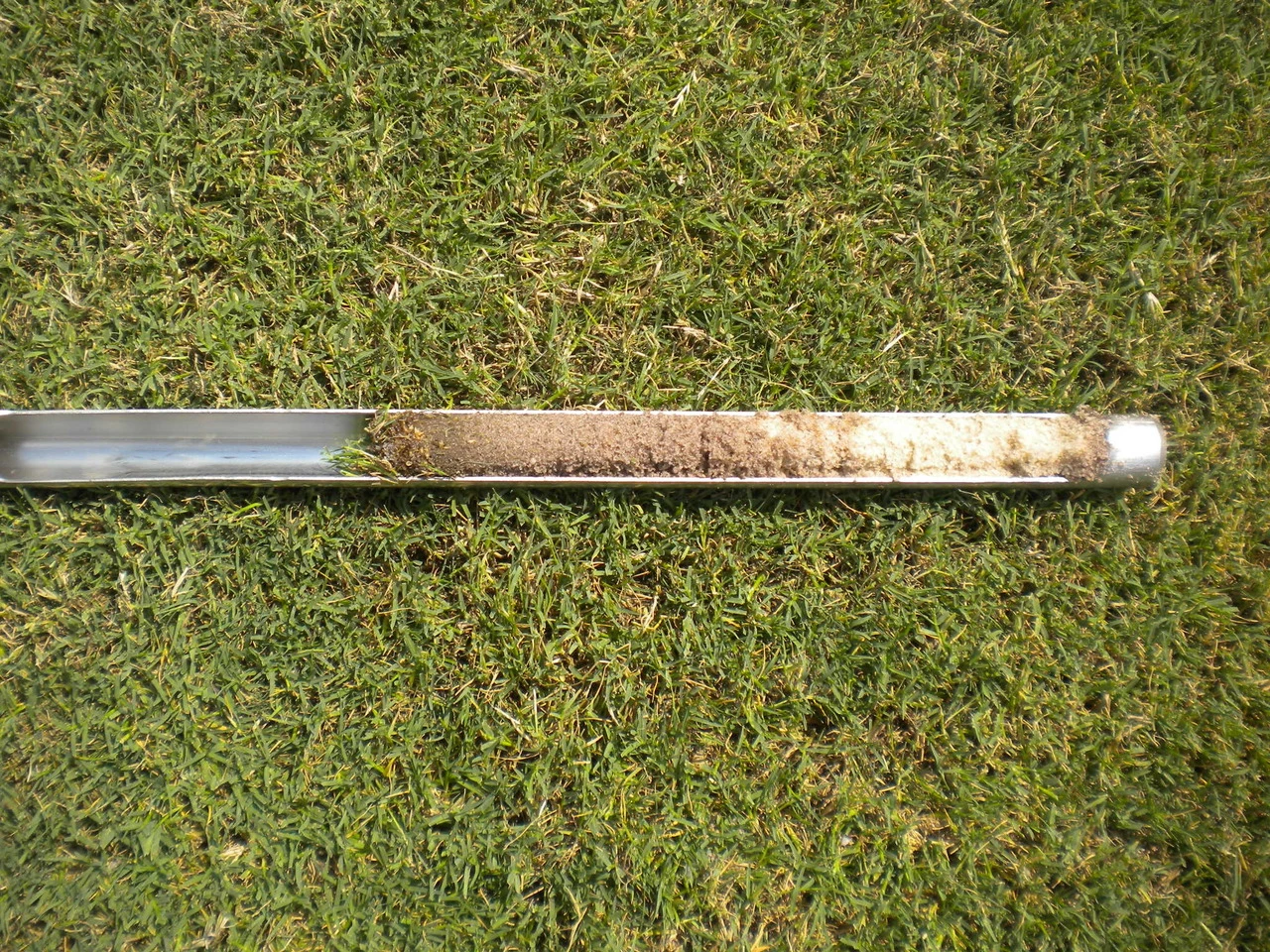
- Take soil from 8 to 10 spots across the same lawn area.
- Sample about 4 inches deep.
- Mix the samples together in a clean plastic bucket.
- Remove grass, roots, and other debris.
- Submit the mixed sample according to your lab’s instructions.
NCDA&CS recommends keeping noticeably different areas separate. For example, a struggling backyard and healthy front lawn may deserve separate samples rather than being mixed together.
Avoid sampling an unusual spot and assuming it represents the entire lawn.
And if you recently applied lime, give it time to react before testing again.
The goal is not simply to learn your pH. It is to learn whether your lawn needs lime and, if it does, how much.
Reading Your Soil Test Report
A soil report can look technical at first. For liming, you mainly need to answer three questions:
- What is my current pH?
- What pH does my grass actually prefer?
- Does the report recommend lime?
Active pH vs. Buffer pH
Your soil pH tells you how acidic the soil is right now.
Buffer pH helps the lab estimate how resistant that soil is to change. This matters because two lawns can both test at pH 5.5 and still need different amounts of lime.
Think of it like heating two houses.
The thermostat tells you the current temperature. The insulation tells you how much work it will take to change it.
Clay soils often resist pH changes more than sandy soils, which is one reason a lab recommendation is more useful than simply looking at the pH number.
NCDA&CS, for example, measures both soil pH and Mehlich buffer pH and uses its testing data to calculate lime recommendations.
Know the Target for Your Grass
There is no single perfect pH for every lawn.
For North Carolina lawns, NCDA&CS recommends roughly:
| Grass type | Preferred soil pH |
|---|---|
| Fescue | 6.0–6.5 |
| Bermudagrass | 6.0–6.5 |
| Zoysiagrass | 6.0–6.5 |
| St. Augustinegrass | 6.0–6.5 |
| Centipedegrass | Around 5.5 |
Centipede is the important exception. Raising a centipede lawn toward 6.5 simply because that number sounds “healthier” can push the soil outside the range the grass prefers.
Cool-season recommendations also vary somewhat by species. Penn State, for example, notes that Kentucky bluegrass generally prefers a higher pH than tall fescue or perennial ryegrass.
What Does Your Result Actually Mean?
Use your grass type as the reference point.
| Your result | What to do |
|---|---|
| Below your grass’s target range | Check the lab’s lime recommendation |
| Within the target range | Do not add lime just because the lawn looks weak |
| Above the target range | Do not lime; investigate why the lawn is struggling |
| Centipede near 5.5 | Usually leave the pH alone unless the test recommends otherwise |
Let the Report Set the Lime Rate
This is the number that matters most.
If your report says 30 lb of lime per 1,000 sq. ft., use that recommendation rather than a generic rate printed on the bag.
The lab has already considered your soil acidity and the target pH for the grass you selected. NCDA&CS reports lime recommendations directly in pounds per 1,000 square feet when correction is needed.
If the recommendation is too high for one surface application, split it according to your testing lab or local extension guidance rather than putting everything down at once.
The simple rule is this:
Do not lime because your pH “looks low.” Lime because your soil report says your grass needs the correction.
When to Apply Lime
If your soil test says you need lime, timing matters less than applying the correct amount under good conditions.
Lime can technically be applied at several points during the year. The best window depends on your climate, grass type, and soil conditions.
Fall Works Well in Many Regions
For cool-season lawns, fall is often an excellent time to lime.
Regular moisture, cooler temperatures, and months of winter weather give limestone time to react before spring growth picks up. Penn State Extension prefers fall applications for this reason, although late winter is also a good option.
In the Carolinas, Winter Can Be a Great Time
This is where generic lawn advice can be misleading.
In North Carolina, lime can be applied any time of year when the soil test calls for it. NC State notes that winter is often a good time because lawn traffic is lower, gentle rains help reduce runoff, and freeze-thaw cycles can help move lime into the soil.
For Charlotte-area lawns, that means you do not need to rush simply because you missed September or October.
Quick Timing Guide
| Lawn / Region | Good Lime Window |
|---|---|
| Cool-season lawns in northern areas | Fall through late winter |
| Transition-zone lawns, including Charlotte | Fall and winter are both practical |
| Warm-season lawns in southern areas | Apply when the soil test calls for it and conditions allow |
| Frozen, saturated, or runoff-prone soil | Wait |
Avoid spreading lime immediately before a heavy storm or onto ground where the product is likely to wash away.
Most importantly, do not lime just because the calendar says it is the “right season.”
The right time to apply lime starts with a soil test showing that your lawn actually needs it.
Types of Lime and How to Choose
Once your soil test says lime is needed, the next question is simple: which kind should you buy?
For most homeowners, the choice comes down to calcium, magnesium, and how easy the product is to spread.
Calcitic vs. Dolomitic Lime
Calcitic lime is mainly calcium carbonate. It raises soil pH while adding calcium.
Dolomitic lime contains both calcium and magnesium carbonate. It makes sense when your soil test shows that magnesium is also low. Penn State recommends dolomitic limestone when both low pH and magnesium deficiency are present.
So do not automatically reach for dolomitic lime because it contains “more nutrients.”
If magnesium is already adequate, adding more does not give your lawn an extra benefit.
Pelletized vs. Ground Agricultural Lime
The difference here is mostly about handling and particle size.
Pelletized lime is finely ground limestone formed into small pellets. The pellets reduce dust and make the product much easier to apply with a normal broadcast or drop spreader.
Ground agricultural lime is usually cheaper, especially for larger areas, but the fine powder can be dusty and harder to spread evenly with homeowner equipment.
| Lime type | Best fit |
|---|---|
| Pelletized calcitic | Magnesium is adequate; easy residential application |
| Pelletized dolomitic | Soil also needs magnesium |
| Ground calcitic | Larger areas where cost matters more than convenience |
| Ground dolomitic | Larger areas with confirmed magnesium deficiency |
One important detail: do not choose lime based only on words like “fast acting.”
How well lime works depends heavily on its fineness and neutralizing value, often listed as CCE, or Calcium Carbonate Equivalent. Finer material reacts more effectively because more limestone comes into contact with the soil.
For the average residential lawn, pelletized lime is usually the easiest product to spread.
Let the soil test decide whether it should be calcitic or dolomitic.
How Much Lime to Apply
Do not guess the rate.
Your soil test should tell you how much lime your lawn needs, usually in pounds per 1,000 square feet for a residential lawn.
That recommendation is based on more than your pH number. Labs may consider your current pH, soil acidity, soil type, target pH, and even recent lime applications. NCDA&CS uses these factors to calculate a specific lime requirement for North Carolina soils.
Why Soil Type Changes the Rate
Two lawns with the same pH may need different amounts of lime.
- Sandy soil usually changes pH more easily, so it often needs less lime.
- Clay soil has a higher buffering capacity, so it may take more lime to make the same correction.
That is especially relevant around Charlotte, where heavier clay soils are common.
What If the Recommendation Is High?
For established lawns, do not assume the entire recommendation should go down at once.
NCDA&CS advises limiting an initial surface application to 50 pounds per 1,000 sq. ft., then applying the remainder after about six months if more is required.
Other extension programs use different limits. Penn State, for example, allows up to 100 pounds per 1,000 sq. ft. on established general turf.
So the safest rule is:
Follow the application guidance from the lab or extension service that produced your soil recommendation.
And remember, more is not better. NCDA&CS warns that over-liming is much harder to correct than applying too little.
Measure your lawn, follow the tested rate, and split the application when required.
How to Apply Lime to Your Lawn
Once you know the correct product and rate, application is fairly simple.
You will need:
- Your soil test recommendation
- The correct lime product
- A broadcast or drop spreader
- Gloves and eye protection
- A dust mask if the product is dusty
Always follow the safety directions on the product label.
1. Measure the Lime You Need
Calculate your lawn size, then use the rate from your soil test.
If the recommendation is 30 pounds per 1,000 sq. ft. and your lawn is 5,000 sq. ft., you need 150 pounds total.
Do not add extra “just to be safe.”
2. Calibrate Your Spreader
Pelletized lime is usually easier to apply with a standard lawn spreader than finely ground agricultural lime. (extension.psu.edu)
Start with a conservative spreader setting rather than dumping the full amount too quickly.
A good approach is to divide the lime in half.
Apply one half while walking in one direction, then apply the other half at a right angle to the first pass. This helps reduce missed areas and heavy spots.
3. Keep Lime on the Lawn
Avoid applying on a windy day, especially if you are using a dusty product.
Sweep any lime that lands on sidewalks, driveways, or other hard surfaces back onto the lawn instead of washing it into a storm drain.
If rain is expected, avoid applying immediately before a heavy downpour that could cause runoff.
4. Record What You Applied
Write down:
- Application date
- Lime type
- Amount applied
- Area treated
That small step makes your next soil test much easier to interpret.
Then wait. Lime works slowly, so resist the urge to apply more because you do not see an immediate change.
How Long Does Lime Take to Work?
Lime works slowly.
If you spread it today, do not expect greener grass next week. Lime is correcting soil acidity, and that process takes time.
What Should You Expect?
A measurable change in soil pH can take several months.
UNH Extension notes that lime may take up to about six months to react, while Penn State recommends planning several months ahead when soil pH needs correction.
The exact speed depends on:
- How finely the limestone is ground
- Soil moisture
- Your starting pH
- Soil type and buffering capacity
- Whether the lime is incorporated into the soil
Finer limestone generally reacts faster because more surface area comes into contact with the soil.
Lime Does Not Move Quickly Through Soil
This is especially important on an established lawn where you cannot till lime into the root zone.
NC State notes that lime moves very little through soil even over one to three years. Most of its effect occurs close to where the material was applied.
That is one reason core aeration can be useful on compacted lawns before liming. Openings in the soil can improve contact below the immediate surface.
Most importantly, be patient.
If your lawn greens up dramatically a few days after liming, the lime probably was not responsible.
Apply the tested rate, give it time to react, and retest before deciding the lawn needs more.
Common Lime Mistakes and How to Fix Them
Most lime problems come from one thing: acting before testing.
Here are the mistakes worth avoiding.
1. Applying Lime Without a Soil Test
This is the big one.
Your lawn can look yellow, thin, or weak even when its pH is already fine. Adding lime anyway wastes money and may eventually push the soil too alkaline.
Penn State recommends applying limestone only when a soil test shows that it is needed.
2. Applying Too Much at Once
More lime does not mean faster results.
Over-liming can raise pH beyond your grass’s preferred range. That can reduce the availability of nutrients such as iron and phosphorus.
If you accidentally applied too much, do not try to flush it away with heavy watering.
Test the soil, stop adding lime, and give the soil time before making another correction.
3. Choosing Dolomitic Lime Automatically
Dolomitic lime adds magnesium along with calcium.
That is useful when magnesium is low. If your soil already has enough magnesium, there is little reason to add more.
Let the soil report make that decision.
4. Ignoring Your Grass Type
Not every lawn wants the same pH.
Centipedegrass is a good example. It prefers more acidic soil than fescue, Bermuda, or zoysia.
Trying to push every lawn toward the same pH can create problems instead of solving them.
5. Applying Under Poor Conditions
There is no universal month when lime suddenly becomes safe or unsafe.
The bigger concern is runoff.
Avoid applying lime to saturated or frozen ground when runoff is likely, or immediately before a heavy storm.
What If Your Soil pH Is Already Too High?
Stop liming first.
If testing confirms that pH needs to come down, elemental sulfur can be used in some situations, but lowering pH is slow and should be based on a measured recommendation rather than another guess.
When lime causes the problem, the answer is not another quick treatment.
Test, measure, and correct slowly.
Frequently Asked Questions
However, hydrated lime and quicklime are different products and can burn turf. Penn State recommends avoiding both on established lawns.
Can lime burn my grass?
Normal agricultural or pelletized limestone is unlikely to burn healthy turf when applied at the tested rate.
Keep children and pets away while you are spreading lime, especially if the material creates dust. Once the product has settled or been watered in as directed, normal lawn use can usually resume according to the label.
Is lime safe for pets and children?
Follow the safety directions on the specific product label.
Retest the soil every few years and apply again only when testing shows the pH has fallen below the target for your grass.
How often should I apply lime?
Do not put lime on a fixed yearly schedule.
There is no universal rule that lawn lime and fertilizer must always be separated by two weeks. The safest approach is to follow your soil-test recommendation and both product labels. Avoid physically mixing products unless the labels specifically allow it.
Can I apply lime and fertilizer at the same time?
Sometimes, yes.
If acidic soil is contributing to weak turf, correcting the pH may help the grass compete better. But moss can also thrive because of shade, excess moisture, poor drainage, or compacted soil. Those conditions still need to be corrected.
Will lime kill moss?
No. Lime is not a moss killer.
You have ruled out one possible cause and saved yourself money. Look next at fertilization, watering, drainage, compaction, disease, or other reasons the lawn may be struggling.
What if my soil test says I do not need lime?
Then do not apply it.
For a residential lawn, tested agricultural lime is usually the more predictable choice.
Can I use wood ash instead of lime?
Wood ash can raise soil pH, but it reacts much faster than ground limestone and also adds nutrients such as potassium. That makes the response harder to control.
Give Your Lawn the Nutrition It Needs
Get a fertilization program designed for healthier color, stronger growth, and better seasonal performance.
Explore Fertilization